
Two years ago neither of us had towed anything. Nathan grew up in Michigan around trucks, but not fifth wheels. Fabiola is from Brazil, where a 40-foot trailer behind a pickup is not a thing you see. Then we bought a Brinkley Model Z 3515 and had to figure out how to move it, on camera, in front of people watching us do it wrong.
This is the guide we wanted at the start. It covers picking the truck, what the weight numbers actually mean, and how hitching goes when you do it every week or two. Where we have a longer post on a piece of it, we link out rather than repeat ourselves.
Start with the weights, not the truck
Everyone starts by asking which truck to buy. The better first question is what the trailer weighs, because that decides the truck.
Four numbers matter:
Trailer weight. What the fifth wheel actually weighs loaded, not the dry weight on the brochure. Ours came in at 17,700 pounds. Every RV gains weight the longer you live in it.
Pin weight. The part of the trailer that presses down on the truck through the hitch. For a fifth wheel this runs roughly 15 to 25 percent of trailer weight. Ours weighed 3,600 pounds, right at 20 percent, which is a healthy ratio for the trailer. Whether it is a healthy number for your truck is a different question, and we are living inside that question right now. More on it below.
Payload. What your truck can carry, on the sticker in the door jamb. This is the number that eliminates trucks, and it catches people out, because pin weight lands on the truck as cargo. Add 3,600 pounds of pin to two adults, a full tank of diesel, tools and a hitch, and a half-ton truck is done before you open the tailgate.
Gross combined weight. Truck and trailer together. Ours weighed 26,220 pounds hitched, with the truck alone at 8,520.
Those numbers came off a CAT scale on a travel day, not a spreadsheet. The full walkthrough of how to run the scale, in what order, and what to do with the ticket is in how to weigh your RV at a CAT scale. Do it early. We put it off for months and the numbers were not what we assumed.
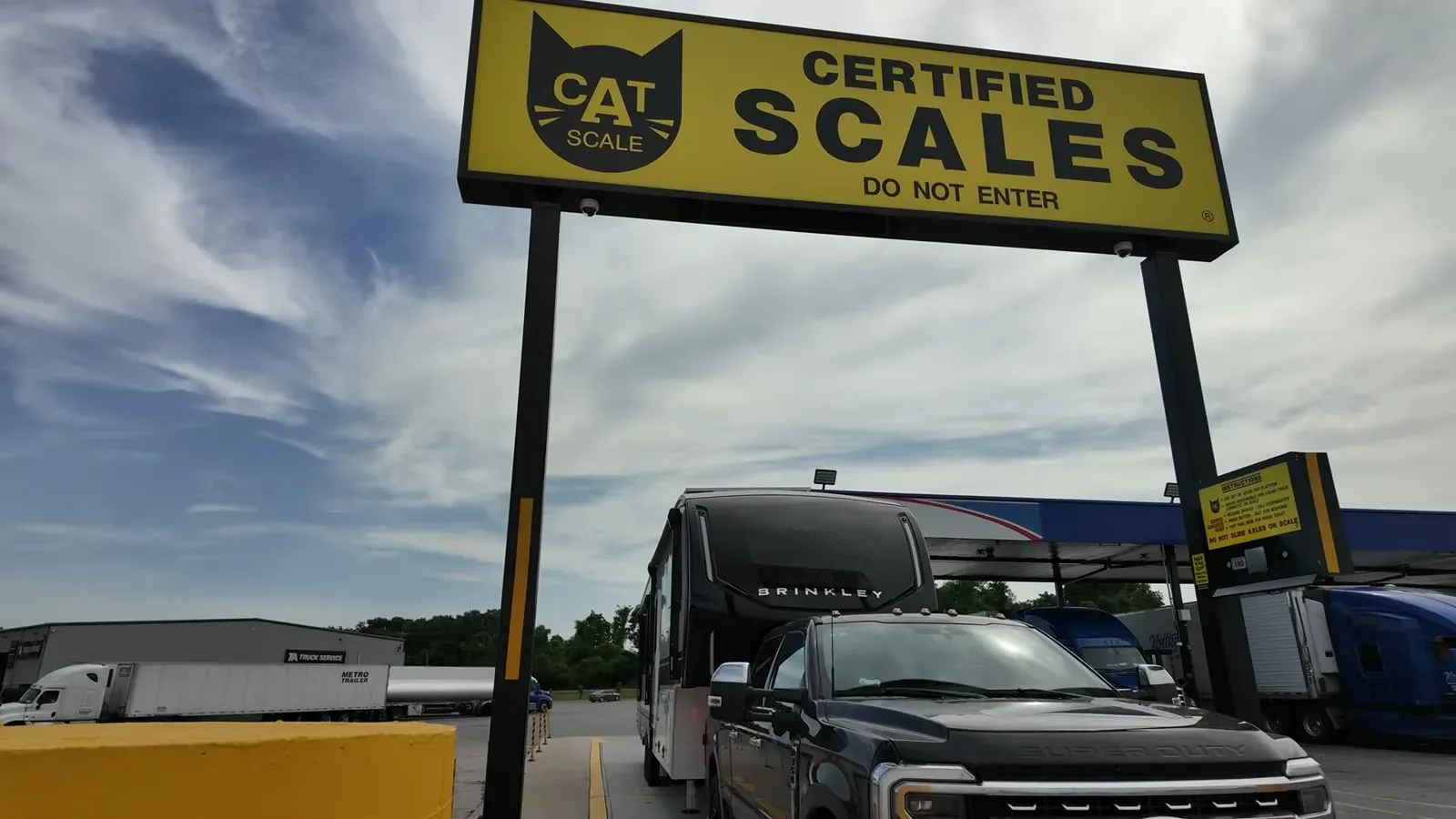
Picking the truck
We spent months on Ford F-350 versus RAM 3500 before landing on an F-350 Platinum, single rear wheel. Both trucks would have pulled our trailer. The comparison is in our Ford versus RAM video if you want the long version.
The general shape of it: a one-ton dually is the comfortable answer for a big fifth wheel, a single rear wheel one-ton works for many of them, and a three-quarter ton is where you need to read your payload sticker carefully instead of trusting a marketing number. Run your own trailer's pin weight against the truck you are considering. Brand loyalty is fun and payload is math.
Two thousand miles of winter driving from Michigan to Florida settled any doubt we had about going bigger rather than smaller. That trip is in our RV inspection video, snow included.
The number that has us shopping for a dually
Here is the part we would rather not be writing, and it is the best argument we can give you for weighing your rig early.
Our F-350 is rated for 3,884 pounds of pin weight. Our trailer put 3,600 on it the day we crossed the scale. That is under the limit, and it was never much of a cushion, and an RV you live in does not get lighter over time.
The truck's onboard scale is telling us we are over it now. What it will not tell us is by how much, because it shows a color and not a number. Red means over. Red does not mean 50 pounds over or 400.
So the next thing on our list is another CAT scale run, loaded the way we actually travel, to turn that color into a figure we can work with. If it says what we suspect it says, the fix is a dually. Trading the truck is cheaper and simpler than trading the house.
None of this means a single rear wheel one-ton cannot tow a big fifth wheel. Ours has hauled this trailer everywhere we have taken it, through mountains and crosswinds and a Michigan winter. It means our particular combination is close enough to the truck's pin weight limit that we want more room, and that we would much rather find that out on a scale than on a downhill grade.
The lesson, if you want it without the expense: weigh before you buy the truck if you can, and weigh again after you have been living in the trailer for a year. Both numbers move.
The hitch
We run a gooseneck setup rather than a traditional fifth wheel hitch. The GEN-Y Executive Torsion-Flex converts the trailer's fifth wheel pin to a gooseneck ball in the truck bed, and the torsion-flex head soaks up a lot of the chucking you would otherwise feel over rough pavement. With the hitch out, the bed is open again, which matters more than we expected when the portable waste tank needs to ride somewhere.
The full writeup of that hitch and the GoosePuck offset ball is in our GEN-Y hitch post, and the rest of the towing kit is in our towing and hitching gear list.
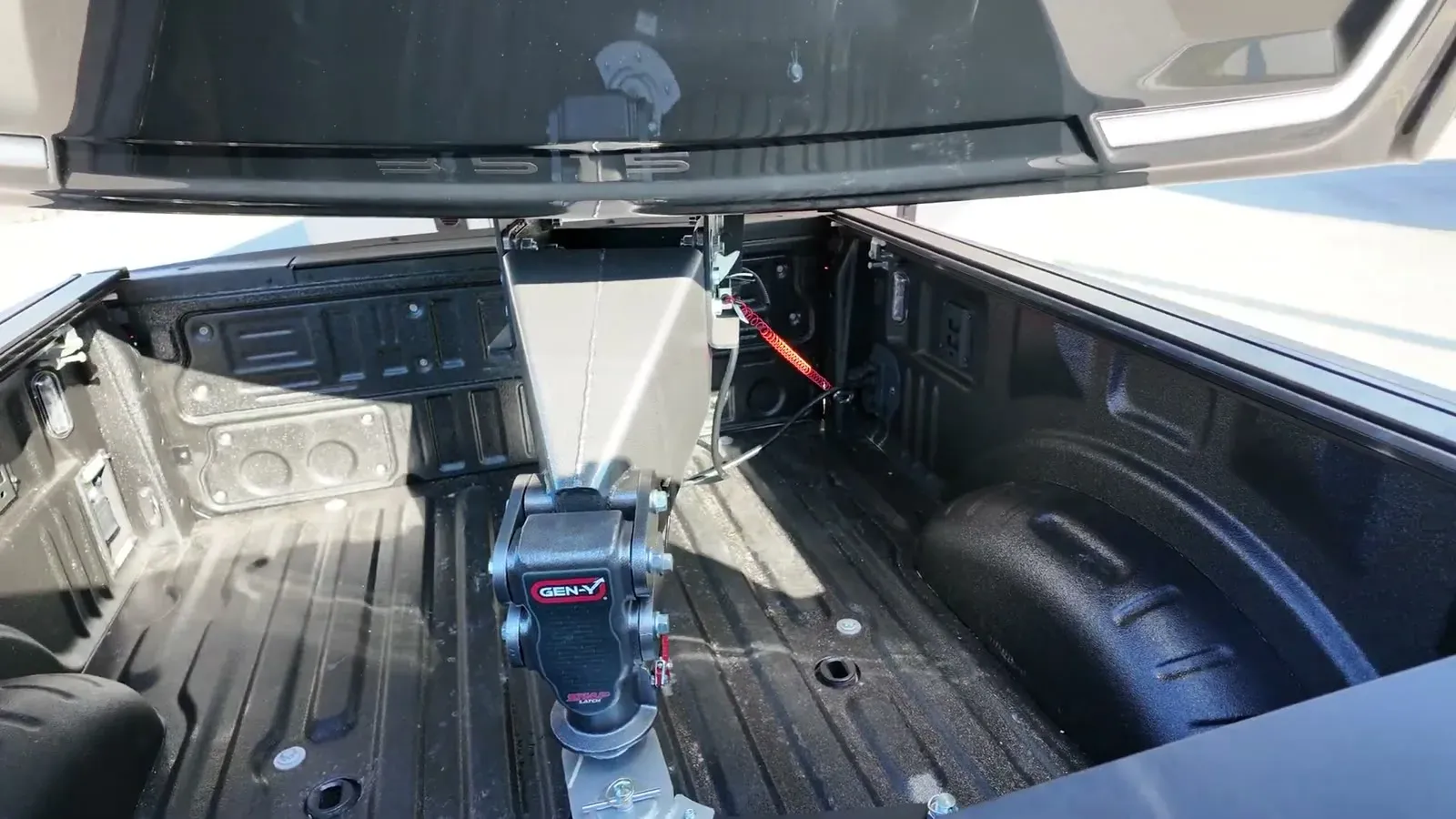
Hitching up
The sequence, once it stops being frightening:
- Line the truck up and back under the pin box slowly. A 360 camera earns its money here. So does a spotter, and so does agreeing in advance on hand signals, because shouting through a closed window has ended more than one calm morning.
- Set the coupler on the ball and listen for the latch.
- Do a pull test. Truck in gear, gentle pull forward against the still-lowered landing gear. If the trailer comes with you, you are hitched. If it does not, better to learn that in a parking lot.
- Plug in the seven-pin, then raise the landing gear.
- Test the trailer lights: left, right, brakes. One person behind the rig, one in the truck. The lights only have power once the seven-pin is in, which is why this step lands here and not earlier.
Step-by-step with photos is in how to hitch a fifth wheel to a gooseneck ball. Our very first attempt without the dealer standing there is this video, and it is not a highlight reel.
One thing nobody tells you: with the trailer off, the gooseneck ball sits in the bed at exactly the height of your skull when you lean in for something. A pool noodle over it costs nothing. Ask us how we know.
Before you pull out
Hitching is one item on a longer list. Ours runs about thirty things, from closing the propane valves to pulling the microwave plate out, and every odd-sounding entry on it exists because something once hit the floor. The whole list, and how we share it live between two phones, is in our RV travel day checklist.
Check tire pressure cold, before the sun has been on the tires. Heavy trailer tires often need full sidewall pressure to carry their rated load, and gas station gauges disagree with each other by several PSI, so pick one decent digital gauge and use it every time.
Driving it
The rig is 40 feet of trailer behind a one-ton pickup. Three things changed how we drive:
Turns are wider than instinct says, and the trailer cuts the corner inside your line. Curbs, gas pumps and the poles at truck stops all live in that gap.
Stopping distance roughly doubles. You leave a following gap that feels absurd and is not.
Fuel stops and campground entrances need planning before you are committed. We use RV LIFE Trip Wizard to route around low bridges and weight limits, because regular map apps do not know your rig has a height, and that is covered in how we plan travel days.
Wind is the one that surprised us. A tall fifth wheel is a sail, and a crosswind on an interstate is a genuinely different driving day.
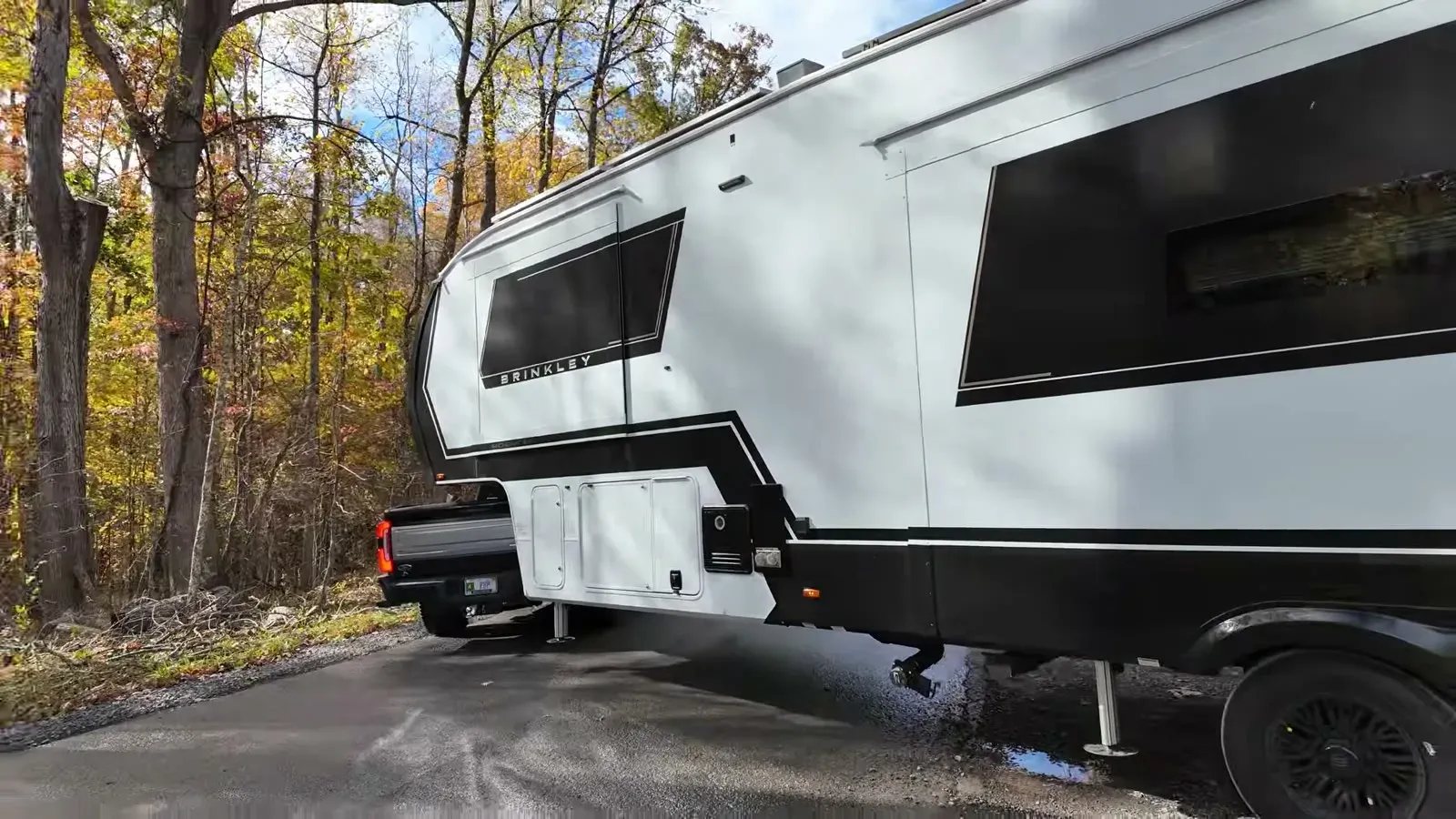
What we got wrong
The mistakes are all on camera. We let two months of full hookups erase our hitching muscle memory and then tried to run a scale, which took most of a morning. We crossed the scale carrying far more fresh water than we normally travel with, so the ticket described a heavier rig than the one we actually drive around, and we spent an evening at a Cracker Barrel backing that water out of the numbers. We ran auto-level on a lot with a long subtle grade and lifted the trailer wheels clean off the ground.
Worth saying, because it surprised us: some of that Cracker Barrel math was not a mistake at all. A CAT ticket gives you axle weights and a gross total. It does not hand you your trailer weight or your pin weight. Those come from crossing the scale a second time with the trailer unhitched and subtracting one ticket from the other. Budget for that. Bring the second pass, and bring a calculator.
The first-travel-day version of all this is our newbie mistakes video. None of it was expensive. All of it was avoidable, and none of it stopped us from doing it again the next week.
This guide describes how we tow our own rig. We are not RV technicians, and your truck, hitch and trailer have their own numbers and their own manuals. Check yours, and double-check anything safety-critical with a professional.