
A fifth wheel hitch and a gooseneck hitch both put the trailer's weight over the truck's rear axle. The difference is how they hold on. A fifth wheel hitch is a big set of jaws in the middle of the bed that grabs a kingpin on the trailer. A gooseneck is a ball in the bed, and the trailer's coupler drops over it.
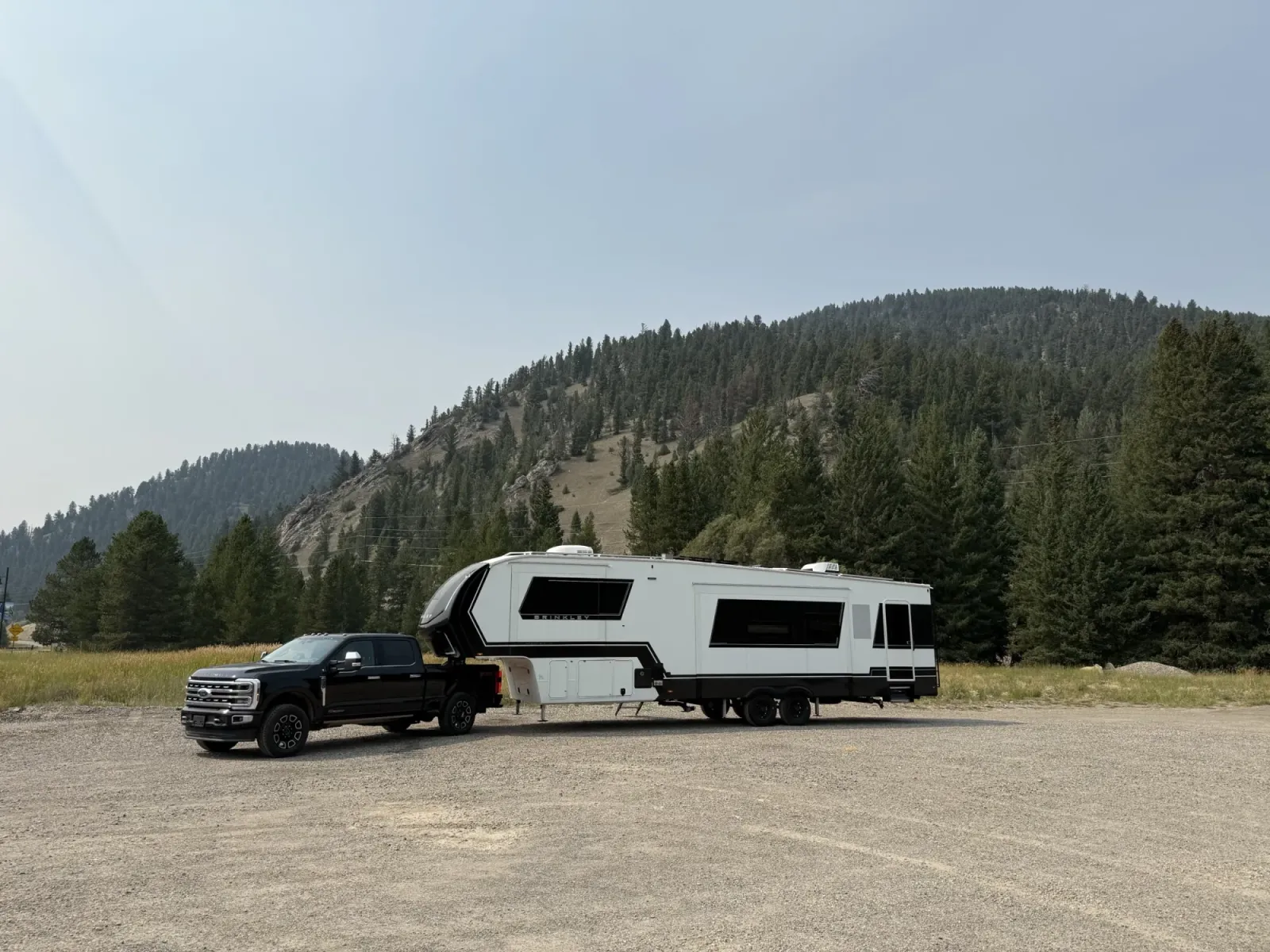
Most fifth wheel RVs come with a kingpin, so most RVers end up with a fifth wheel hitch. We tow ours, a 40-foot Brinkley Model Z 3515, on a gooseneck ball instead, using an adapter that replaced the trailer's pin box. Here is how the two compare, where the general advice comes from, and what towing the less common way has been like for us.
Some links on this page are affiliate or partner links. If you buy or sign up through them, we may earn a commission or referral reward at no extra cost to you. As an Amazon Associate we earn from qualifying purchases.
How each one connects
Fifth wheel hitch. The trailer has a kingpin hanging under its nose, at the bottom of the pin box. In the truck bed sits a hitch head on a base or rails. You back under, the pin slides into the jaws, and the jaws lock around it.
Gooseneck hitch. The truck has a ball, 2 5/16 inches on RV setups like ours, mounted in or under the bed. The trailer has a coupler at the end of a long arm. You line the ball up under the coupler, lower the trailer onto it, and latch it. A gooseneck hookup also gets safety chains between the trailer and the truck.
Gooseneck hitches are common on livestock, flatbed and work trailers. Lippert, the RV parts maker, sums it up as fifth wheels for RVs and campers, goosenecks for livestock, flatbed and commercial trailers.
Gooseneck vs 5th wheel at a glance
The general comparison below comes from Lippert's own write-up (June 2025). The last column is what we have actually seen on our own rig.
| Fifth wheel hitch | Gooseneck hitch | On our rig | |
|---|---|---|---|
| Connection | Kingpin locks into jaws | Coupler latches over a ball | GEN-Y SnapLatch coupler on a 2 5/16-inch ball |
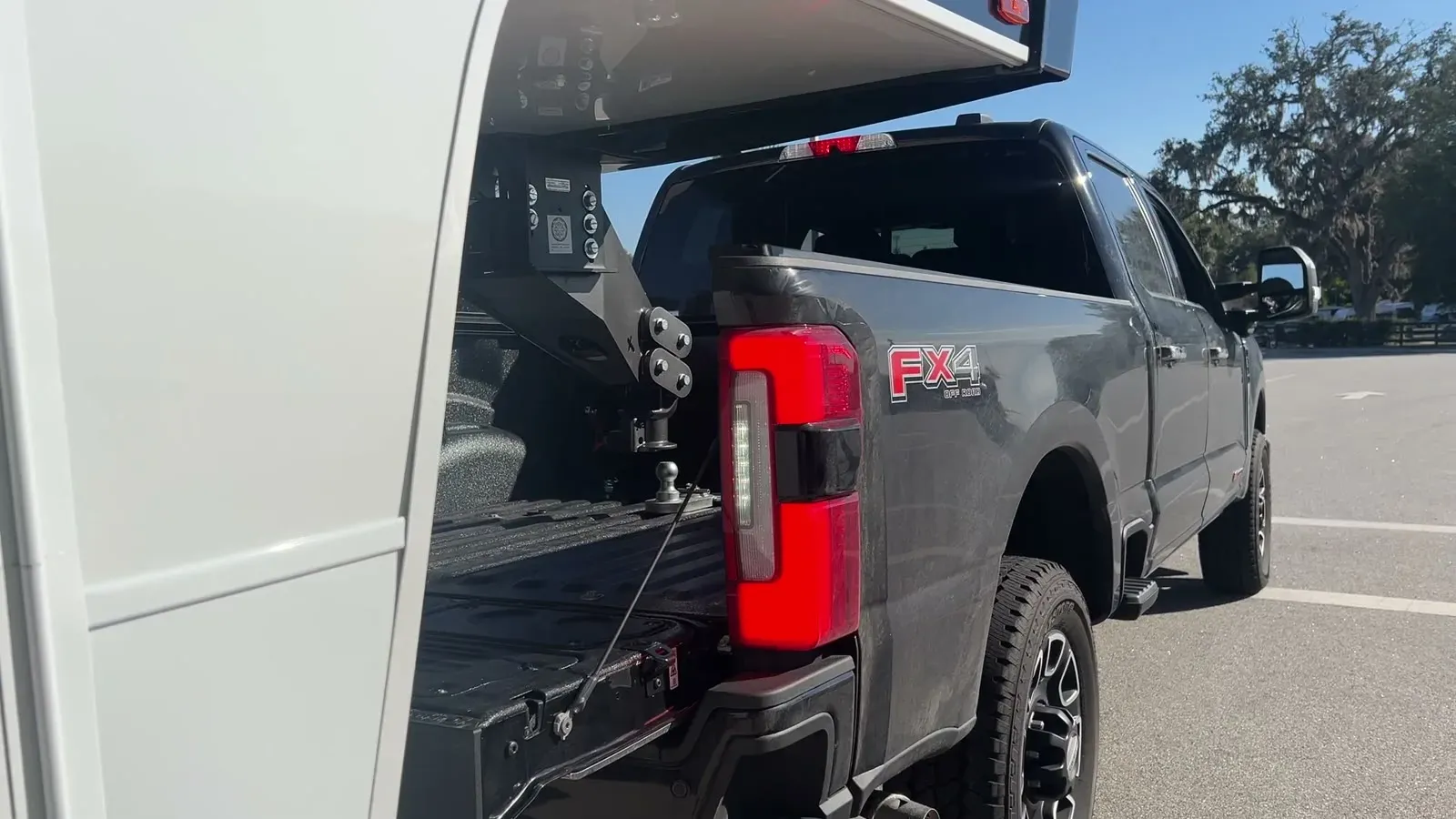
| Truck bed | Takes much more room; base rails usually stay even when the head comes out | Ball can be removed or flipped on many setups, leaving the bed almost open | Just the ball in the middle, on a puck we could take out easily; it wears a pool noodle |
| Hitching | Generally easier to hitch and unhitch | Less forgiving to hook up | Lining the ball up under the coupler was the hard part for us |
| Ride | Smoother and quieter, especially over long distances | Tends to pass more vibration and road shock into the truck | Our adapter has shock-absorbing parts built in, and it feels pretty smooth, but we have nothing to compare it to |
| Cost | Generally more expensive | More affordable overall | Our adapter came with the RV; the ball cost us $466.59 |
| Capacity | 16,000 to 30,000 lb | 25,000 to 38,000 lb | Our trailer weighed 17,700 lb on a CAT scale |
Capacity ranges are for the hitch categories. Your real limit is the lowest-rated part of the whole setup, and for a lot of RVers that turns out to be the truck.
Can you tow a fifth wheel RV with a gooseneck hitch?
Yes, with an adapter. There is no way to put a kingpin on a ball, so something on the trailer has to change. The kind we use, the GEN-Y Executive, replaces the trailer's pin box with one that ends in a gooseneck coupler. What it replaces, how it gets installed and what it costs are in our 5th wheel to gooseneck adapter review.
Two cautions from Lippert are worth reading before you buy one. Check with your trailer's manufacturer first, so the adapter doesn't cause a warranty problem. And adapters can change how the trailer rides, which is why Lippert calls them better as a temporary or secondary setup. GEN-Y's answer to the ride question is the Torsion-Flex design, which uses rubber torsion arms to isolate shock. We haven't towed on a regular pin box, so we can't compare the two from the driver's seat.
Why we chose a gooseneck
We wanted the truck bed available when we're not towing. Right now the only thing in it is the ball in the middle, on an offset puck that we could easily take out if we wanted to. That makes it easy to throw in extra groceries or haul things back and forth.
We've never towed with a fifth wheel hitch, so what we know about them comes from watching a lot of videos. What we saw is that they take up a lot of space, and that they're heavy and a hard job to take out when you want to use the bed. With the gooseneck we never have to do that.
Two honest caveats. The weight doesn't disappear: the heavy part moved from being attached to the truck to being attached to the RV, and we don't know how the two setups compare on weight. And the ride. We'd heard the GEN-Y was good for smoother rides, because it has shock-absorbing parts built in. Ours feels pretty smooth, but it's the only setup we've towed with, so we can't compare.
Would we do it again? Yes. We're very happy with the hitch and the coupler, and if we were buying everything again we'd get the GEN-Y in what we think is a slightly newer version. We use an offset ball because our truck has a short bed. With a longer bed, we'd skip the offset and use the regular puck. The full review is in our 5th wheel to gooseneck adapter review.
What towing on a gooseneck has been like for us
We had never towed anything before the Brinkley, and it has been on the gooseneck ball since the day we picked it up. So everything here is gooseneck experience. We're not comparing it to years on a fifth wheel hitch.
We settled on the gooseneck setup early. By August 2024, before our truck had even been ordered, we were telling the Ford dealer that the trailer would have a GEN-Y gooseneck and the truck needed a ball to hook it to. The RV dealer installed the GEN-Y on the trailer as part of our purchase. When the truck turned out to be a short bed, we bought a GoosePuck 5-inch offset ball for extra clearance between the trailer and the back of the cab. It drops into the F-350's factory puck system, so there's no separate hitch bolted under the bed.
Hitching is the part that took us longest to learn. The ball is a small target you can't see from the driver's seat. Our first solo attempt ran into the dark and ended after about an hour with the trailer still unhitched. The next day, on our first travel day, it came together much faster, and these days it's routine. The full procedure is in how to hitch a fifth wheel to a gooseneck ball.
One thing the hitch style doesn't change is pin weight. Our trailer put 3,600 pounds on the truck at a CAT scale, against a 3,884-pound limit on our F-350, and it would weigh the same on a fifth wheel hitch. That margin is why we're shopping for a dually, and it's covered in how to tow a fifth wheel.
Upkeep is small. Nathan greases the ball and the hitch, and after each move he cleans the grease off so it doesn't get on anything. Otherwise the whole bed is free.
What we got wrong
We let the dealer do the first hookup and didn't write the steps down, so that night we couldn't repeat it. If you're new to a gooseneck, practice the whole sequence yourself while someone who knows it is still standing there.
We also started our first solo attempt too late in the day. Backup cameras wash out in headlights, and a spotter you can't see is no help. Give yourself daylight for the first few.
And make sure you have safety chains. Our GEN-Y came through our RV dealer, and they didn't give us any. Don't tow without them.
Gooseneck vs 5th wheel FAQ
What is the difference between a gooseneck and a 5th wheel hitch?
A fifth wheel hitch uses jaws in the truck bed that lock around a kingpin on the trailer. A gooseneck uses a ball in the truck bed, with a coupler on the trailer that latches over it. Both carry the trailer's pin weight over the truck's rear axle.
Is a gooseneck or a 5th wheel hitch better for an RV?
Most fifth wheel RVs are built for a fifth wheel hitch, and Lippert describes that setup as the smoother, quieter ride and the easier one to hitch. A gooseneck leaves more of the bed free and usually costs less, but an RV needs an adapter to use one. We chose a gooseneck to keep the truck bed free, and it works for us, but we haven't towed on a fifth wheel hitch to compare.
Can you pull a 5th wheel with a gooseneck hitch?
Yes, with a 5th wheel to gooseneck adapter on the trailer. Ours is a GEN-Y Executive, which replaces the pin box. Check with your trailer's manufacturer first. Our adapter review covers the details.
Which is easier to hitch, a gooseneck or a 5th wheel?
Lippert calls the fifth wheel hitch generally easier. Our own experience fits that: lining a small ball up under the coupler, from a seat where you can't see it, was the part we struggled with.
Does a gooseneck hitch take up less truck bed space?
Usually, yes. A fifth wheel hitch's base or rails tend to stay in the bed. A gooseneck ball can often be removed or flipped. Ours is a puck-mounted ball that we could take out easily, but we leave it in, so the bed is open apart from the ball in the middle.
Do gooseneck hitches need safety chains?
Yes. A gooseneck hookup gets safety chains between the trailer and the truck. How we hook ours up is in our gooseneck hitching guide.
The rest of our towing setup
Everything else that rides along on a travel day is in our towing, hitching and setup gear list. Two more pieces of our travel-day setup:
The AUTO-VOX CampSync four-camera system lets us see the traffic behind us and down both sides while we tow. AUTO-VOX sent us the kit for free and paid us to feature it in a video. Our deal: code NOMADA88 for 10% off on Amazon, valid through October 31, 2026. Get it on Amazon.
RV LIFE Trip Wizard is how we plan every travel day. It knows our rig's height and weight and routes us around low bridges. Our deal: a 7-day free trial on the annual RV LIFE Pro plan through our link.
This describes how we tow our own rig. We are not RV technicians, and your truck, hitch and trailer have their own ratings and manuals. Check yours, check with your trailer's manufacturer before changing its pin box, and double-check anything safety-critical with a professional.