
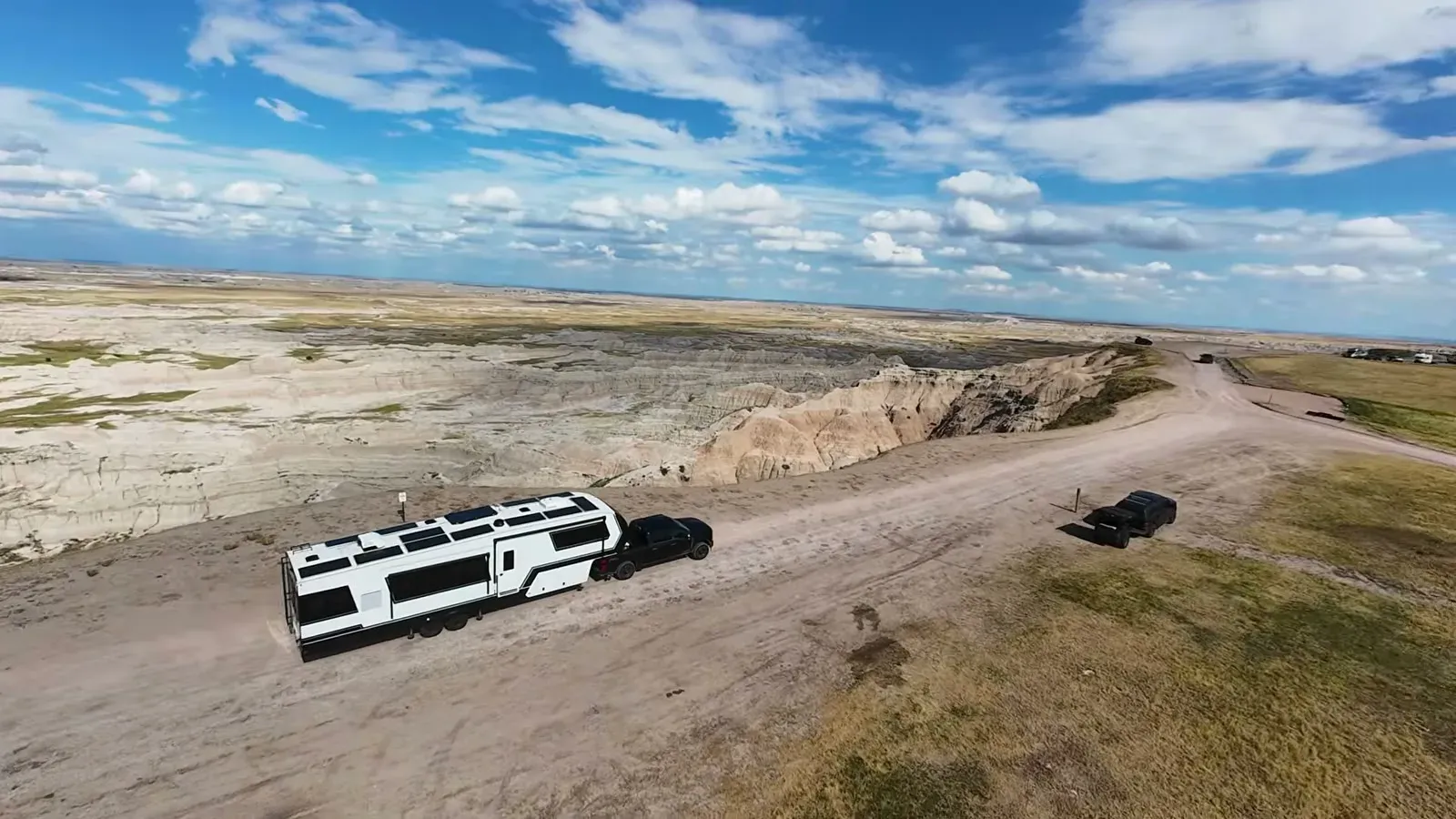
We live full-time in a Brinkley Model Z 3515 fifth wheel, and we do not carry a generator. Everything in the rig, from the air conditioner to the air fryer to the Starlink and laptops we work from all day, runs on a solar and battery system that was installed before we ever spent a single night camping. Our very first trip was a 15-day boondocking challenge in Central Florida, which in hindsight was a bold way to find out whether the system actually worked.
It did, mostly. We filmed the whole thing for our YouTube channel, Nomads Amor, including the week shade nearly killed our batteries. Since then we have boondocked in Florida heat and Wisconsin heat advisories, and the setup has become the one piece of our rig we get asked about more than anything else.
So here is our full Brinkley RV off-grid solar setup: who designed it, what batteries and panels we run, the Victron gear that ties it all together, and the two small devices that protect the whole investment.
Some links on this page are affiliate links, including Amazon links. As Amazon Associates we earn from qualifying purchases, at no extra cost to you. We only list gear we actually own and use.
Who designed and installed it
Mobile Solar Consulting
We did not design this system ourselves. Mobile Solar Consulting did, and they also handled the installation. We dropped the Brinkley off with them, and when we picked it up we drove straight to our first boondocking spot at Dupuis in Central Florida. You can read about that trip, including a walkthrough of the fresh install, in our first boondocking video post.
If you are thinking about solar for your own rig, whether a full professional install or a DIY project where you just want someone experienced to sanity-check your plan, they are who we point people to. Their shop is here, and the promo code NOMADSAMOR gets you half off their design consultation package, or a free soft starter for your AC with a qualifying installation.
Upgrading solar on a Brinkley: factory package vs what we added
A lot of people land on this page looking for a Brinkley RV solar upgrade, so here is the split between what comes on the roof from the factory and what our installation added.
What Brinkley's factory solar package includes
Brinkley's current feature list for the Model Z 3515 (on its Model Z 3515 page, checked October 2026) includes a 370 watt solar panel, described as "740 watt ready," and a 50-amp MPPT solar controller listed as inverter prep and lithium ready. The same list includes a dual Group 27 battery box, wire conduit from the roof to the interior and basement for aftermarket upgrades, and prewiring for a generator of up to 5.5k in the front storage compartment.
Ours is a 2025 and came with the 370 watt panel, which is still up there, and a factory charge controller. We never did find out exactly which controller it was. Mobile Solar standardized the whole system on Victron gear that all talks together, so the factory controller came out, and we gave it away.
What our solar installation added
Everything else on this page was added by Mobile Solar Consulting in January 2025, right after we bought the rig. We drove the Brinkley about 300 miles to drop it off for the install, and that drive turned into our first travel day. In short:
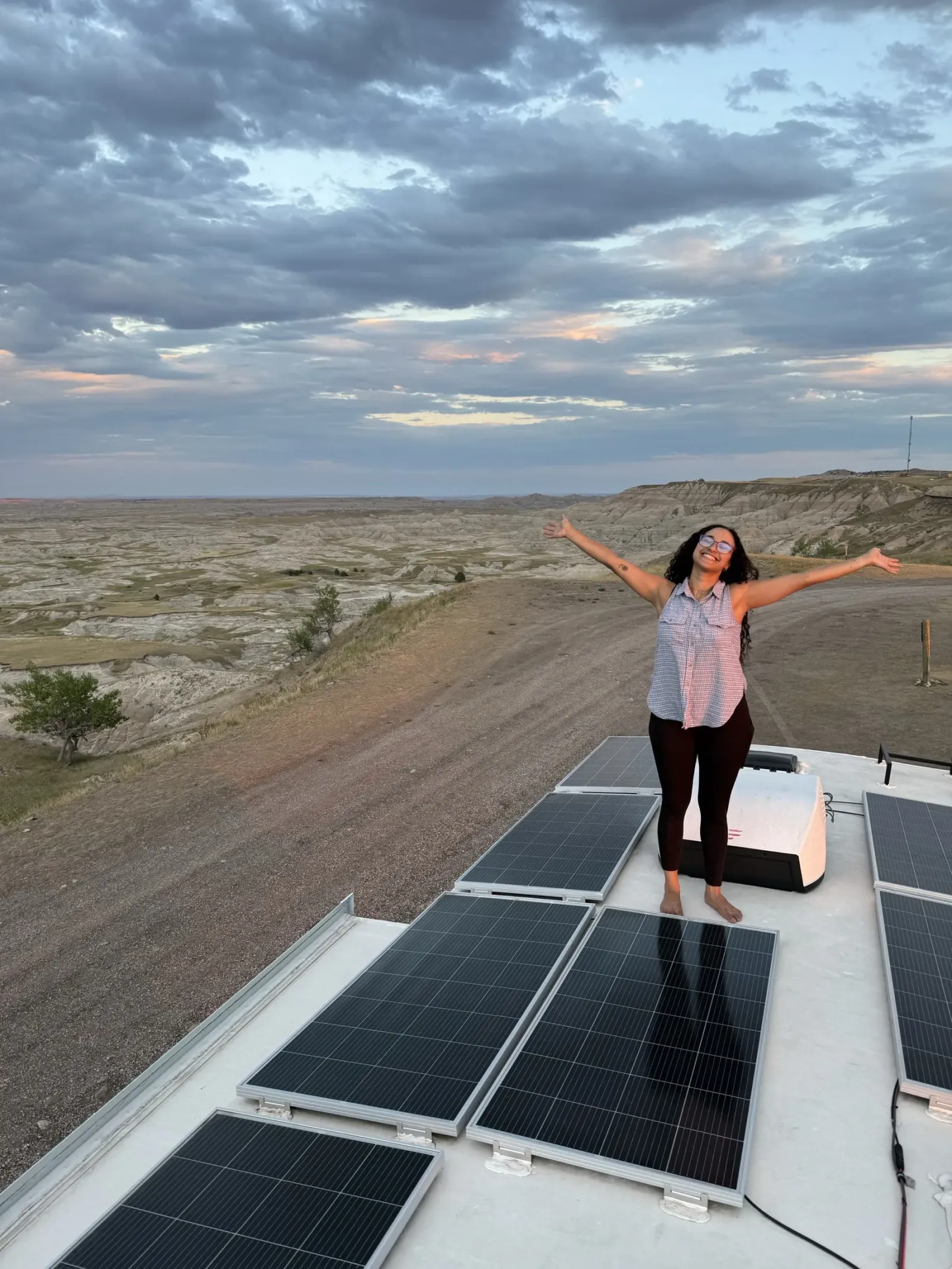
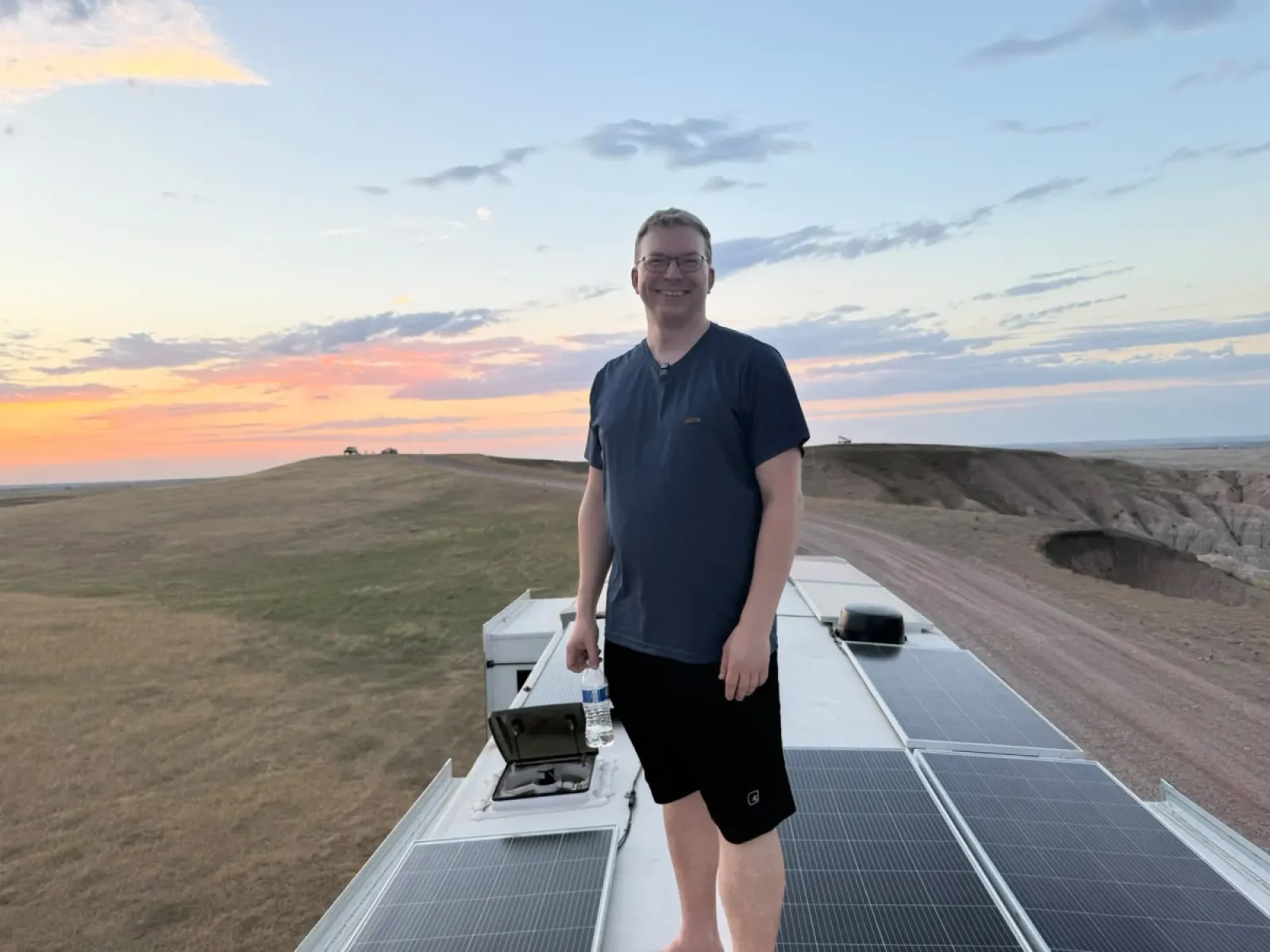
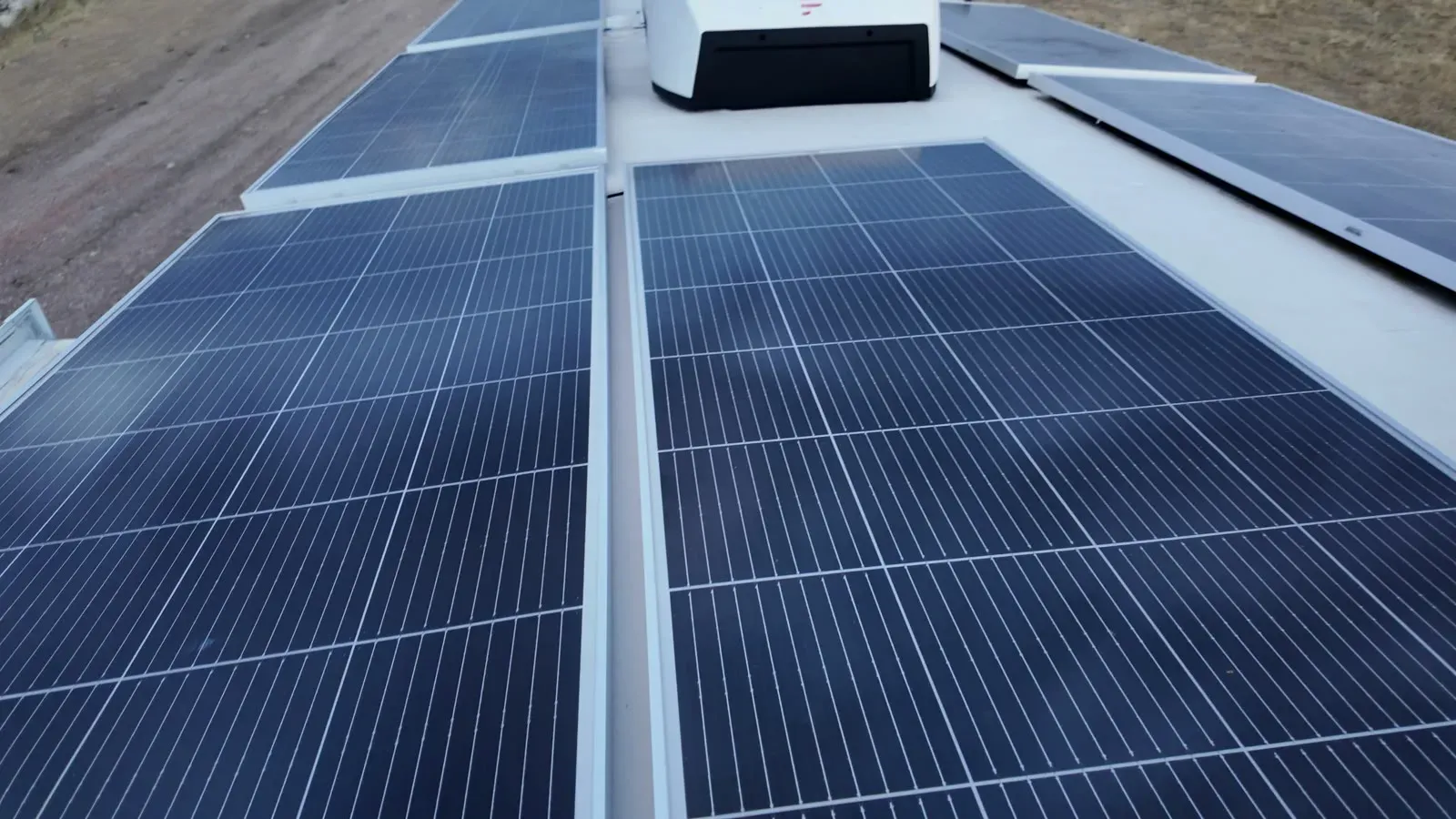
- Twelve RICH SOLAR 200 watt panels, which with the factory panel come to about 2,770 watts
- Six SOK 24V 100Ah lithium batteries, plus a 12V 100Ah lithium battery as a backup
- Two Victron MultiPlus 3000VA inverter/chargers
- Two SmartSolar MPPT charge controllers: the 250V/85A for the new array, and the 100V/20A for the factory panel on its own
- A Cerbo GX with a GX Touch 70 screen, a Lynx power distributor, a Smart Battery Shunt, and two Orion-Tr DC-DC chargers that step the 24 volt bank down for the rig's 12 volt systems
- A Micro-Air EasyStart soft starter for the air conditioner
On the same visit they mounted our Starlink dish on the roof, which has been extremely useful because it keeps working while we tow. If you're getting Starlink, order directly from Starlink through our referral link and you get a free month of service, credited after your new service activates. Starlink sets the exact terms, so check the referral offer shown at checkout.
Why the bank is 24 volt, and why there are two inverters and two controllers, has its own post: why our RV runs a 24V battery bank and two inverters.
What our solar installation cost
Mobile Solar Consulting's invoice came to roughly $23,000. About $1,000 of that was the Starlink roof mount, so the solar and battery system itself was roughly $22,000, including about 60 hours of installation labor.
What the upgrade changed for us
We don't carry a generator. The air conditioner, the air fryer, the Starlink and our laptops all run on this system, and our first trip with it was fifteen days of boondocking in Central Florida. The one time it nearly failed us was our own doing: we parked in shade and ended up borrowing a generator, which is all in our stuck-without-power post.
Getting a solar installation for your own Brinkley
We point people to Mobile Solar Consulting, whether you want a full installation or a DIY plan checked. Code NOMADSAMOR gets you half off their design consultation package, or a free AC soft starter with a qualifying installation. Their shop is here. For the rest of the rig, specs and price included, see our Brinkley Model Z 3515.
The batteries
SOK lithium batteries
The battery bank is the heart of the system, and ours is built on six SOK 24V 100Ah lithium batteries, with a smaller 100Ah 12V marine lithium battery alongside them for backup. They are what let us run the fridge, the coffee grinder, and yes, the air conditioner, without shore power or a generator humming outside.
Lithium was the obvious choice for full-timing. The batteries charge fast from the panels, hold their voltage under heavy loads, and we can pull them down much further than lead acid without hurting them. We check on them constantly (more on how below), and through all our boondocking so far they have not given us a reason to worry. You can grab them on Amazon.
The one time they got into real trouble was our fault, not theirs. Near the end of our 15-day challenge we were parked in shade with no generator on board, and we watched the bank drain lower every day until we had to borrow a generator. That whole scramble is in our stuck-without-power post, and it taught us the most important solar lesson there is: the best battery bank in the world cannot help you if your panels never see the sun.
The panels
RICH SOLAR 200 watt panels
Up on the roof we run twelve RICH SOLAR 200 watt monocrystalline panels, which together with the 370 watt panel the Brinkley came with from the factory give us right around 2,770 watts of solar. There is nothing exotic about them, which is kind of the point. They are flat, they are efficient, and on a clear Florida or Wisconsin day they pour enough power into the bank that we stop thinking about electricity at all.
That shade incident changed how we camp with them. Now, picking a boondocking site starts with the sun: which way the panels will face, what trees will do at 4 pm, whether we can angle the rig for the longest exposure. We talked through that site-picking habit during our week boondocking in Wisconsin. If you are shopping panels, the ones we use are on Amazon.
The Victron gear that runs it all
Everything between the panels and the outlets is Victron. Mobile Solar Consulting spec'd the whole stack, and having one brand across the system means every component talks to every other component.
Victron MultiPlus 3000VA inverter/charger
The MultiPlus is what turns battery power into normal household power. We actually run two of them, which is what lets us pull big loads like the air conditioner and the air fryer at the same time instead of choosing one or the other. They are pure sine wave inverters, so laptops, the TV, and kitchen appliances all run exactly like they would at home, and when we do plug into shore power they flip around and become the battery charger. The first meal we cooked on our Blackstone came with a side of fries from the air fryer, running entirely off these inverters in the middle of nowhere. They are on Amazon here.
Victron SmartSolar MPPT charge controllers
The charge controllers take whatever the panels produce and feed it to the batteries at the right voltage. We run two: a big SmartSolar MPPT 250V/85A that handles the main roof array, and a smaller SmartSolar MPPT 100V/20A alongside it. Both have Bluetooth, so we can open the Victron app from bed and see exactly how many watts are coming in. On sunny travel-prep mornings that number is very satisfying. On shady afternoons it is a warning.
Victron GX Touch 70 display
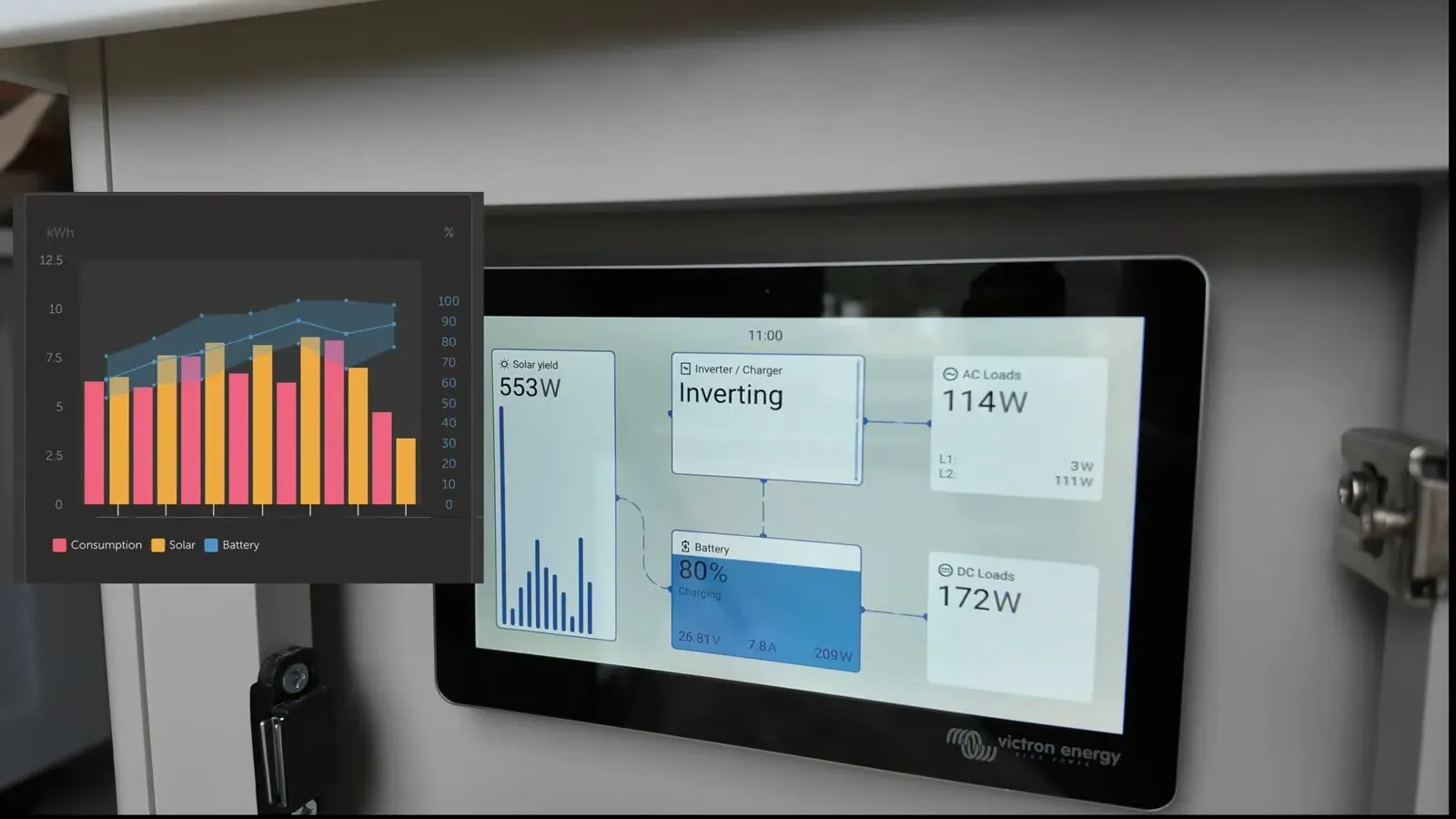
The GX Touch 70 is a seven inch touchscreen mounted inside the rig, paired with a Victron Cerbo GX behind the scenes that gathers data from every component. Together they show the whole system on one screen: solar coming in, loads going out, battery state of charge. Our regular battery check-ins in the videos are usually us standing in front of this screen, like the ones during our first 15-day challenge. No crawling into the basement, no guessing. It is on Amazon.
Victron Smart Battery Shunt
The shunt is the least glamorous part and maybe the most important. It sits on the negative side of the battery bank and counts every amp in and out, which is how the system knows the real state of charge instead of a voltage-based guess. Without it, the pretty numbers on the GX Touch would be fiction. You can find it here on Amazon.
The rest of the install
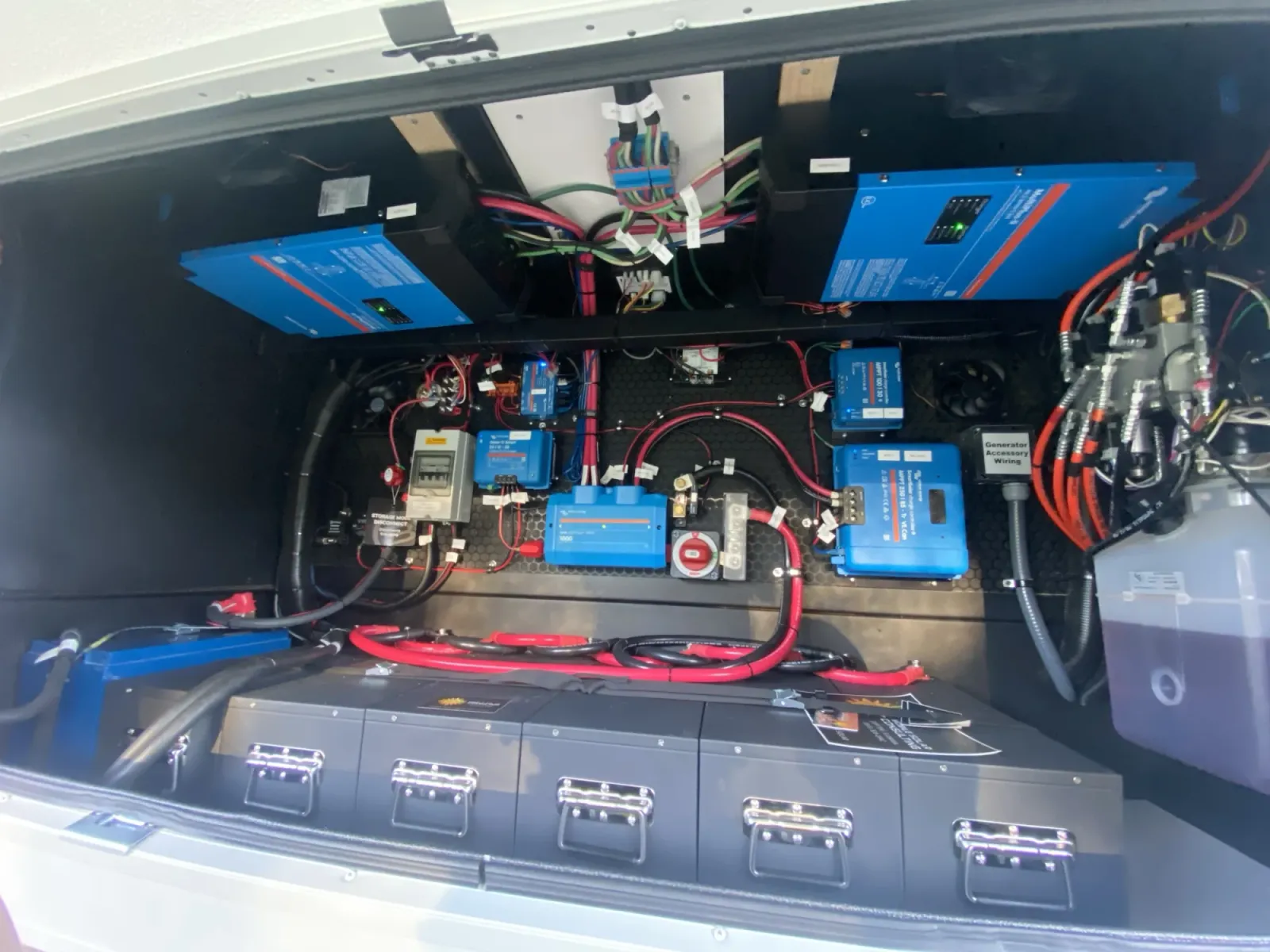
Between the big pieces sits the glue that makes a system this size safe. A Victron Lynx power distributor ties the bank together on a single busbar, a pair of Orion-Tr DC-DC chargers step our 24 volts down to run the 12 volt gear in the rig, and battery disconnect switches plus fused solar disconnects let us shut sections down when we need to work on anything. Mobile Solar Consulting spec'd and wired all of it, and it is the part we are happiest we did not try to figure out on our own.
Protecting the system
Micro-Air EasyStart Breeze soft starter
Air conditioners take a huge surge of power at the moment the compressor kicks on, and that startup spike is what usually makes AC-on-batteries impossible. The EasyStart Breeze smooths that spike out, so our inverter can start the AC without breaking a sweat. If running your air conditioner off-grid is part of your solar dream, budget for one of these. It is on Amazon here.
Power Watchdog 50A surge protector
When we do stay at a campground, the Power Watchdog is the first thing out of the basement. It sits between the pedestal and our cord and checks the power before any of it reaches our electronics. After spending this much on batteries and inverters, plugging straight into an unknown pedestal feels like skipping the seatbelt. Ours is the Bluetooth 50 amp model, available on Amazon.
The whole system in one list
Every component on this page is saved in our Solar & Batteries idea list on Amazon, and the rest of our gear lives in our Amazon storefront.
If you are building out a rig, the solar system is only one piece. Our full-time RV gear list covers everything else we carry, and our boondocking setup shows how the power system fits together with water and waste when there are no hookups at all. We also cover the monitoring side of the rig in our safety and monitoring gear post.
And if you want to hear how the next boondocking spot treats this system, the newsletter is where we share what broke, what worked, and where we are headed next.