
Nobody buys an RV because they are excited about sewer hoses. We are Nathan and Fabiola, we live full-time in a Brinkley Model Z 3515 fifth wheel, and we can tell you that tank management is the one chore that never goes away. Every place we park, whether it is a full-hookup site or a friend's driveway, the tanks fill up on the same schedule.
We learned most of this on camera. Two weeks into living in the Brinkley, our tanks hit full while we were moochdocking with no sewer connection, and we had to figure out the portable tote and macerator routine in real time. The cheap starter hose leaked, the tote would not fill right until we sorted out venting, and the tank sensors turned out to be more of a suggestion than a measurement. That whole messy afternoon is on our Nomads Amor channel, and the gear below is what we settled on afterward.
This is everything sewer and tank related that lives in our basement storage right now. None of it is glamorous. All of it keeps the worst chore in RV life from becoming an actual disaster.
Some links on this page are affiliate links, including Amazon links. As Amazon Associates we earn from qualifying purchases, at no extra cost to you. We only list gear we actually own and use.
The hose setup
Camco RhinoEXTREME 20' sewer hose kit
Our first sewer hose was the cheap kind that comes in a starter kit, and it leaked. We tell that story, mess and all, in our tank dumping episode, and it convinced us that the sewer hose is the one place you do not save ten dollars. We swapped to the RhinoEXTREME kit and have not had a leak since.
The kit comes pre-assembled with 20 feet of hose, swivel fittings, and a clear elbow so you can see when the water finally runs clean. The hose itself is a thicker TPE material that shrugs off being dragged across gravel, and it holds whatever bend you put in it instead of springing back. You can find the kit on Amazon.
Camco Sidewinder 15' sewer hose support
A sewer hose lying flat on the ground drains badly and leaves stuff sitting in the low spots. The Sidewinder is a folding plastic support that cradles the hose and steps it downhill from the RV outlet to the sewer inlet, so everything actually flows the direction you want. The sections telescope, which lets us route around rocks and utility posts instead of over them.
It folds up accordion style and slides into the basement next to the hose. We set it up at every site with a sewer connection and honestly forget about it until pack-up day, which is the best thing we can say about any piece of sewer gear. It is on Amazon.
Valterra T58 twist-on waste valve
The gate valves that come built into an RV do not always seal forever, and the first warning you get is a surprise when you pull the sewer cap. The Valterra T58 twists onto the outlet and adds a second valve between the tanks and the cap, so any seepage stays behind a gate you control instead of landing on your shoes.
We installed ours as one of the first outside projects on the rig, and you can see it in our full-time RV tour. It cost less than a nice lunch and has made every single hookup and disconnect cleaner. It is on Amazon here.
Dumping without a sewer connection
We spend a lot of nights moochdocking and boondocking, which means no sewer hookup and tanks that fill anyway. This is the gear that lets us stay parked instead of breaking camp every few days to find a dump station.
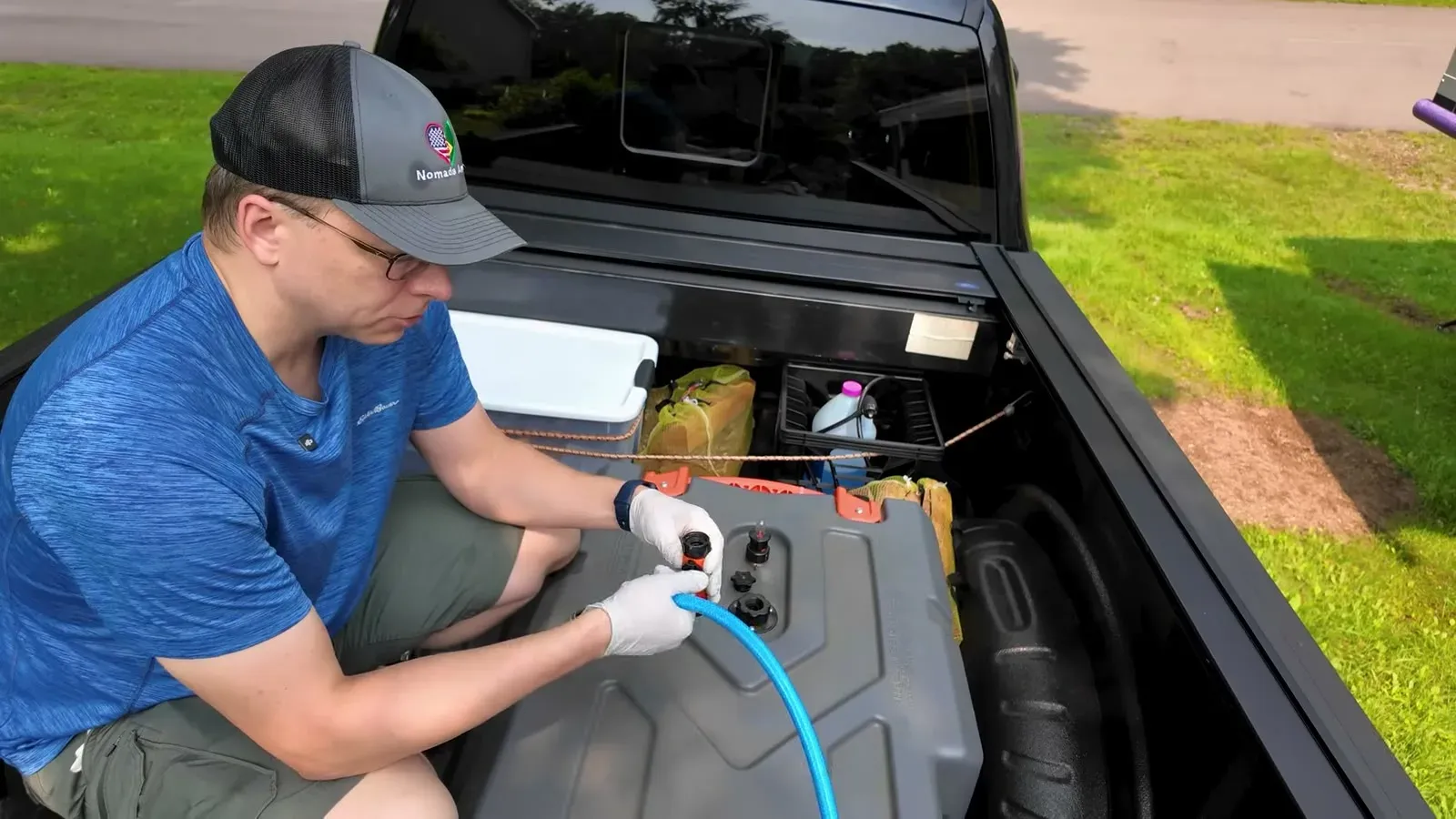
Camco Rhino 36-gallon tote tank
The Rhino tote is a 36-gallon portable tank on no-flat wheels. We fill it from the RV, hook the steel tow adapter to the truck hitch, and roll it to the dump station while the rig stays put. Thirty six gallons is enough to make a real dent in our gray and black tanks in one trip, and it has a built-in gate valve so nothing escapes on the drive.
Our first session with it was a learning experience. We started with the kitchen gray to practice, moved on to black, and discovered the hard way that the side fill port and proper venting matter a lot if you want the tank to actually fill instead of burping air back at you. The whole process, wins and whoops included, is in the tank dumping video. The tote is on Amazon.
Two accessories are worth adding. The Rhino tote tank gauge threads on like a garden hose fitting and lets the tank vent while filling or dumping, which fixes exactly the flow problem we fumbled through on camera. And since the tote rides outside in the sun, the Rhino nylon cover with its cinch strap and drain grommet keeps UV and weather from aging the plastic while it waits between uses.
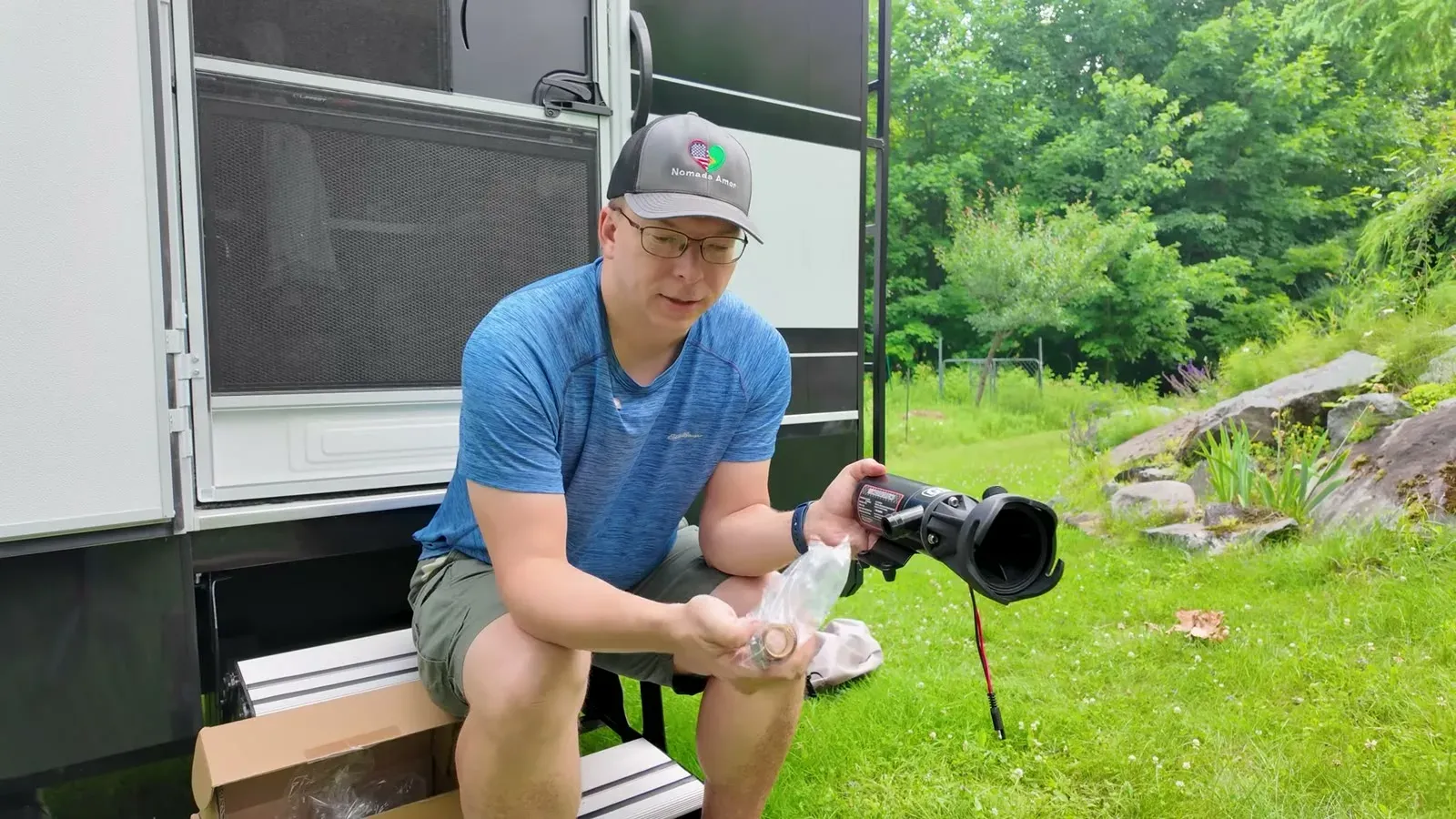
12V portable macerator pump
The macerator is the other half of the tote system. It grinds waste and pumps it through a smaller hose instead of relying on gravity, which matters because gravity is rarely on your side when the tote sits higher than the outlet or the run is long. Ours clips to 12 volt power, and it moved everything from the rig into the tote without us lifting anything heavier than a hose.
It also gives you options a plain hose does not, like pumping uphill or over a distance to wherever the tote is parked. After using it for that first full dumping session, it earned a permanent spot in the basement. You can find it on Amazon.
Black tank treatment, and what actually keeps a tank clean
This is the question we get most about tanks, and the honest answer is that treatment is the smaller half of it. What keeps a black tank from becoming a problem is water and timing. Treatment helps with odor and breakdown on top of that, and it cannot rescue a tank you are running dry.
Put water in before anything else
After every dump, put a few gallons back in the black tank before it gets used again. A tank with liquid already in it lets solids break up and move. A tank being filled from empty is how you get the cone of compacted waste under the toilet that people call the pyramid, and how you get a sensor that reads full forever afterward.
Use more water than feels necessary
Almost every black tank complaint traces back to not enough water. Flush longer than seems reasonable. The tank needs volume to carry solids out when you pull the valve, and water is cheaper than the alternative.
Dump when it is about two-thirds full, not sooner
It is tempting to dump early because the valve is right there at a full hookup site. Resist it. You want enough volume behind the solids to flush them out in one go. Dribbling out a quarter-full tank leaves the heavy material sitting where it was.
Do not let it sit for weeks
This is the one we learned by accident. We went about two weeks between dealing with our kitchen tank once, and then did it again after a much shorter stretch, and the difference in how cleanly it came out was obvious. Whatever your schedule is, shorter is easier. Full details of that dump day, including the pump that quit halfway through, are in our macerator pump guide.
What we actually do, and what treatment is for
Being straight about our own position first, because this page only lists gear we really use: we do not run a tank treatment on a schedule. We tried one that came to us as a sample, and the rest of the time we flush the black tank with water and rely on the four habits above. That is not us saying treatments do not work. It is us telling you that a rig can be kept in good shape without one, which is not what most gear pages will tell you.
Tank treatments come in two broad families. Enzyme and bacterial products work by digesting waste and paper over time, and they need a reasonably warm tank and a few days to do much. Chemical deodorizers act faster and are mostly about controlling odor rather than breaking anything down.
Either way, the job of a treatment is odor control and helping solids break up. It is not a substitute for water, it will not clear an existing blockage, and it will not fix a sensor that is already coated. If your tank smells and you are doing the four things above, treatment is the right next lever. If you are not doing them, treatment is an expensive air freshener.
The clear elbow is your gauge
The RhinoEXTREME kit above comes with a clear elbow, and this is where it earns its place. Flush until what is running through it is actually clear, not almost clear. Our tank sensors have been unreliable since about week two of owning the rig. The elbow has never lied to us.
The cleanup bucket
4.2-gallon collapsible mop bucket
Every dump day ends with rinsing something: fittings, gloves, the clear elbow, your hands. We keep a big collapsible mop bucket just for the dirty jobs, and because it folds flat, it takes up almost no storage space, which is the whole battle in a fifth wheel.
It has done double duty too. When we tested how much water was really left in our fresh tank during our 15-day boondocking challenge, buckets were the measuring tool. At 4.2 gallons it is big enough to be useful and small enough for Fabiola to carry when full. It is on Amazon.
The whole kit in one place
Most of the gear on this page lives on two of our Amazon idea lists: RV Must Haves for the hose setup and Boondocking for the tote and macerator. Everything else we carry is on our Amazon storefront.
Tanks are only one system in a full-time rig. These cover the rest of ours:
- The RV gear we actually use full-time
- Our boondocking setup: water, power and waste off-grid
- Our RV water filtration and water gear
And if you would rather watch us figure this stuff out the hard way, our newsletter is where we share new videos and what we learned filming them.