
The GEN-Y GH-8045AL Executive Torsion-Flex is a gooseneck hitch that converts a fifth wheel's kingpin to a gooseneck ball connection in the truck bed, and the GEN-Y GoosePuck is the 5-inch offset ball it locks onto. Together they're how our Ford F-350 has pulled our 40-foot Brinkley Model Z 3515 since day one, and we're very happy with both. If we were buying everything again, we'd get the GEN-Y again, in what we think is a slightly newer version.
If you searched for a 5th wheel to gooseneck adapter, this is one. GEN-Y calls the Executive a "Fifth Wheel-to-Gooseneck" pin box: it bolts onto the trailer in place of the factory pin box and ends in a coupler that drops over a 2 5/16-inch gooseneck ball, so the truck needs a ball in the bed instead of a fifth wheel hitch.
Some links on this page are affiliate or partner links. As Amazon Associates we earn from qualifying purchases, at no extra cost to you. We only recommend gear we actually own and use.
What a 5th wheel to gooseneck adapter replaces, and how it works
A fifth wheel trailer normally hangs its front end on a kingpin, a steel pin under the nose. On the trailer, that pin sits at the bottom of the pin box, the steel arm bolted to the frame. On the truck, the pin locks into the jaws of a fifth wheel hitch, a heavy head and base that sit in the middle of the bed.
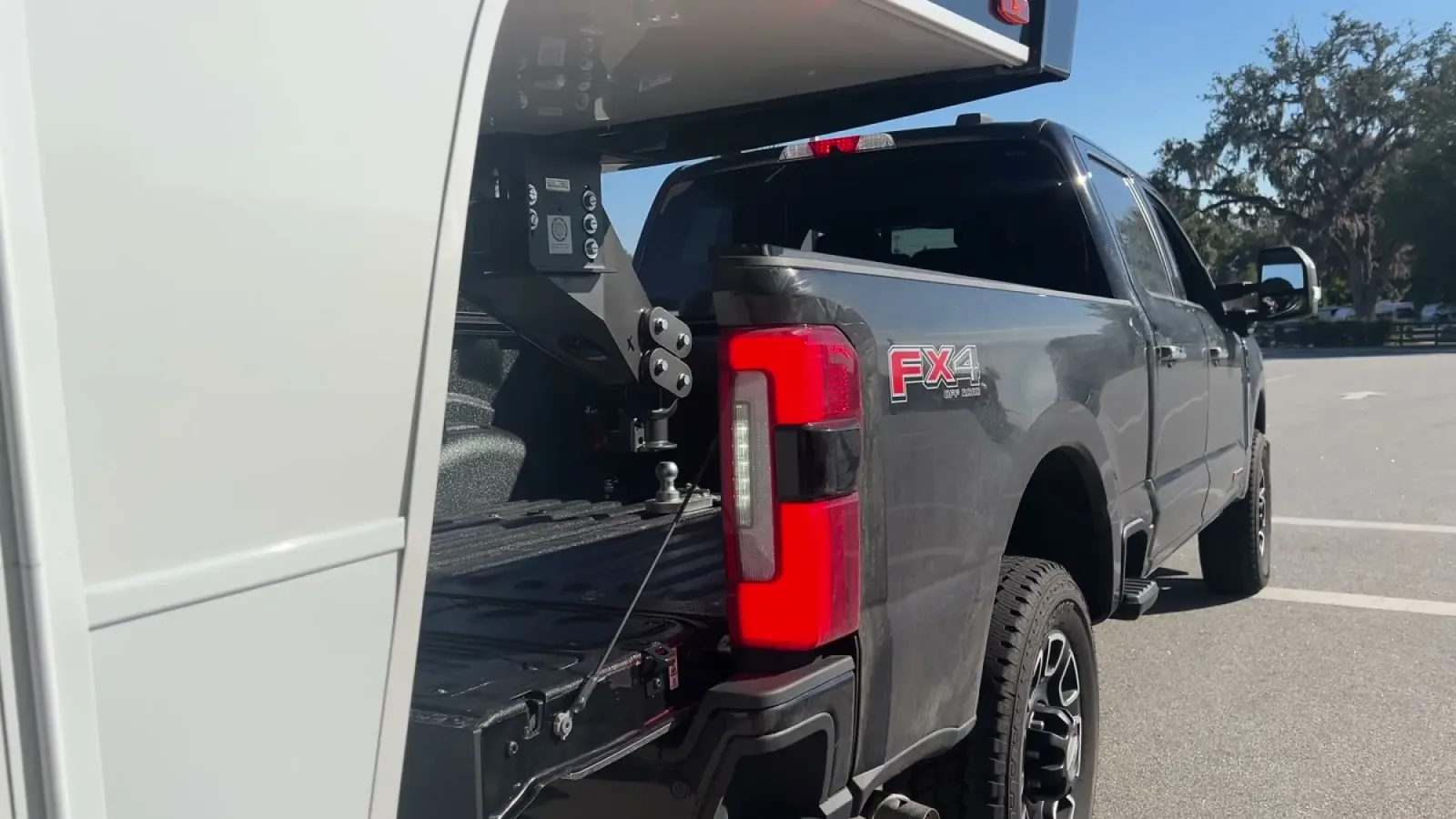
An adapter like the Executive changes the trailer side. The original pin box comes off and the GEN-Y box goes on in its place, ending in a SnapLatch gooseneck coupler instead of a kingpin. The truck side shrinks to a single gooseneck ball. On a truck with a factory puck system, like our F-350, that ball can be a puck-mounted ball such as the GoosePuck, so nothing else has to be bolted under the bed.
The "Torsion-Flex" part is a set of rubber torsion arms inside the box that flex under load. GEN-Y says they cut the shock that travels between trailer and truck, and that customers report up to 90% smoother towing. That is the manufacturer's number, not one we measured.
A few things to check before you order, all from GEN-Y's own listing (checked October 2026):
- Your frame. The gooseneck Executive is sold per trailer frame type, such as LCI Rhino Box, Lippert 1621, 1621 HD, 1116 and 1716, and LCI Turning Point. Some frames also need GEN-Y's shim plates.
- Your weight tier. It comes in tiers by trailer weight, rated for 4,500 or 6,500 pounds of pin weight depending on the model. Use your loaded weight off a scale, not the brochure's dry weight. GEN-Y also notes that tow capacity is limited by the lowest-rated part of the setup.
- Your ball. The coupler is made for a 2 5/16-inch ball, and GEN-Y says this model works with a recessed ball whose top sits within 1 inch of the truck bed.
How it gets installed, and what it cost us
GEN-Y's Executive installation guide (updated March 2026) is short. Remove anything attached to the old pin box, like the power cord box, breakaway switch and lights. Take out all but one bolt on each side, support the box, then pull the last two and lower it. Lift the Executive into place, using the bolt pattern's 2 inches of vertical adjustment to get the trailer towing level, add shim plates if your frame needs them, and run at least four bolts per side torqued to 160 ft-lb. Re-torque after the first 50 miles. GEN-Y recommends 6 to 8 inches of clearance between the trailer and your bed rails.
We did not do this ourselves. The dealer that sold us the Brinkley installed the GEN-Y before we picked the trailer up, and the hitch and its installation were part of our RV purchase. So we can't give you a separate price for ours. For reference, GEN-Y lists the gooseneck Executive at $1,799.95 to $1,999.95 depending on frame and weight tier (checked October 2026).
The GoosePuck we bought ourselves, straight from GEN-Y, in December 2024. Our truck turned out to be a short bed, and we picked the 5-inch offset to give the trailer some extra clearance at the back of the cab. With a discount and shipping it came to $466.59. GEN-Y now sells the GoosePuck GEN 2, which lists at $529.95 for Ford trucks from 2017 on (checked October 2026).
Why we bought it
We wanted the truck bed free when we're not towing. With the GEN-Y, the only thing in the bed is the ball in the middle, and ours sits on a puck that we could easily take out if we wanted to. That leaves the bed open for extra groceries or for hauling things back and forth.
We've never towed with a fifth wheel hitch, so this part comes from watching a lot of videos rather than from experience: those hitches take up a lot of space, and they're heavy and hard to take out when you want the bed back. With the gooseneck we never have to. The weight doesn't vanish, though. The heavy part just moved from the truck to the RV, and we don't know how the two setups compare on weight. We lay the two side by side in gooseneck vs 5th wheel hitch.
We'd also heard the GEN-Y gives a smoother ride, because it has shock-absorbing parts built in to soak up some of the movement. It feels pretty smooth to us. We can't compare it to anything else, because it's the only setup we've towed with.
The GoosePuck GH-21001 is the other half. It drops into the factory puck system in the F-350's bed with no drilling or under-bed hardware, and the 5-inch offset moves the ball back toward the tailgate, which gives the front of the trailer extra clearance from the cab in tight turns. We use the offset because our truck has a short bed. With a longer bed, we'd skip the offset and use the regular puck.
How we use it
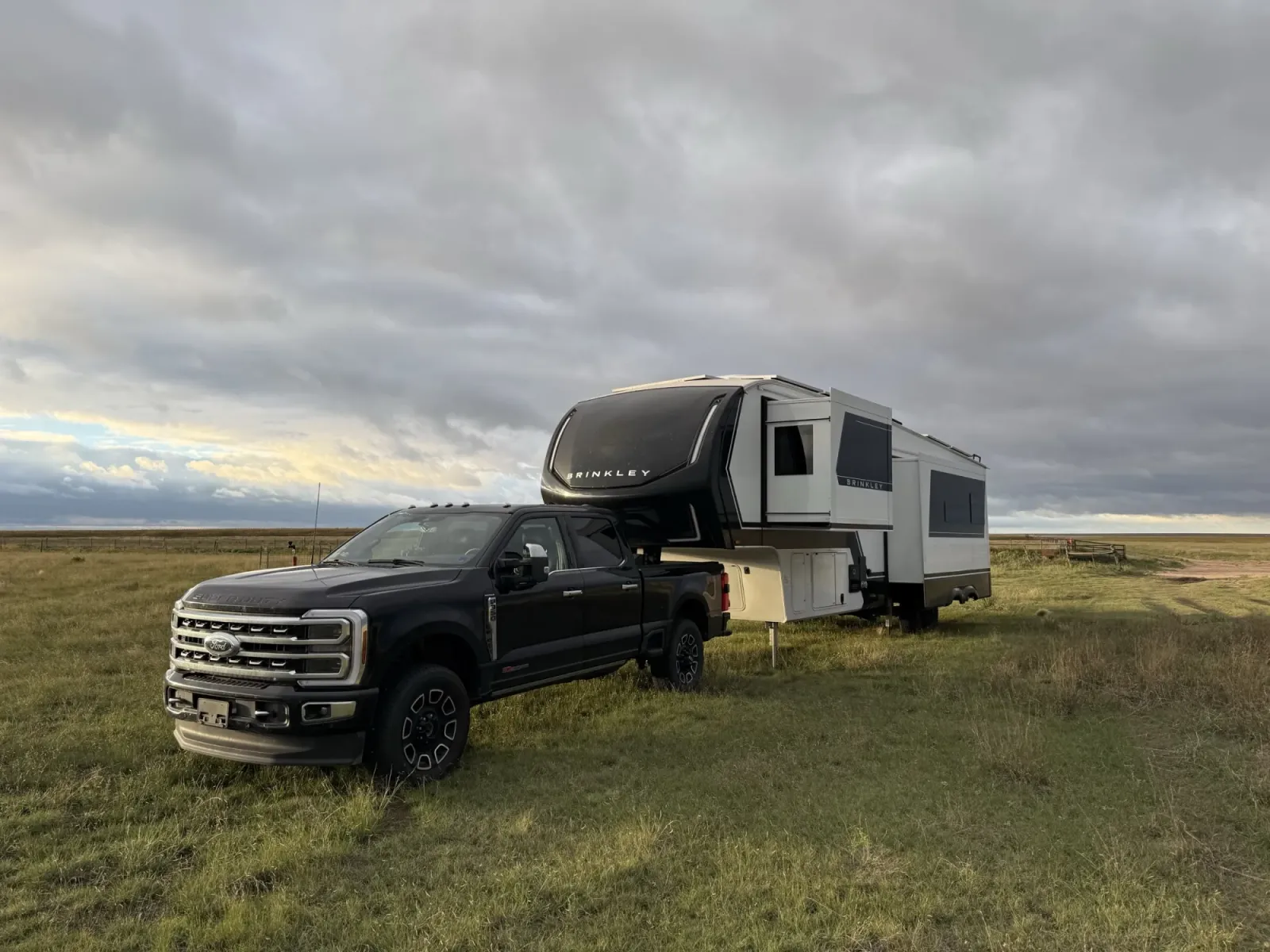
Our first hitch-up happened the day we picked up the Brinkley, with the dealer coaching us through every step and both of us double-checking everything twice. We filmed it, along with our first laps around the lot and a parking attempt that humbled us, in our first hauling day post. The real test came at the end of that same day, when we tried to hitch back up entirely by ourselves. It got dark, the backup camera washed out in the headlights, and after about an hour we gave up for the night. The next try, on our first travel day, came together far faster. The step-by-step we wish we'd had is in how to hitch a fifth wheel to a gooseneck ball.
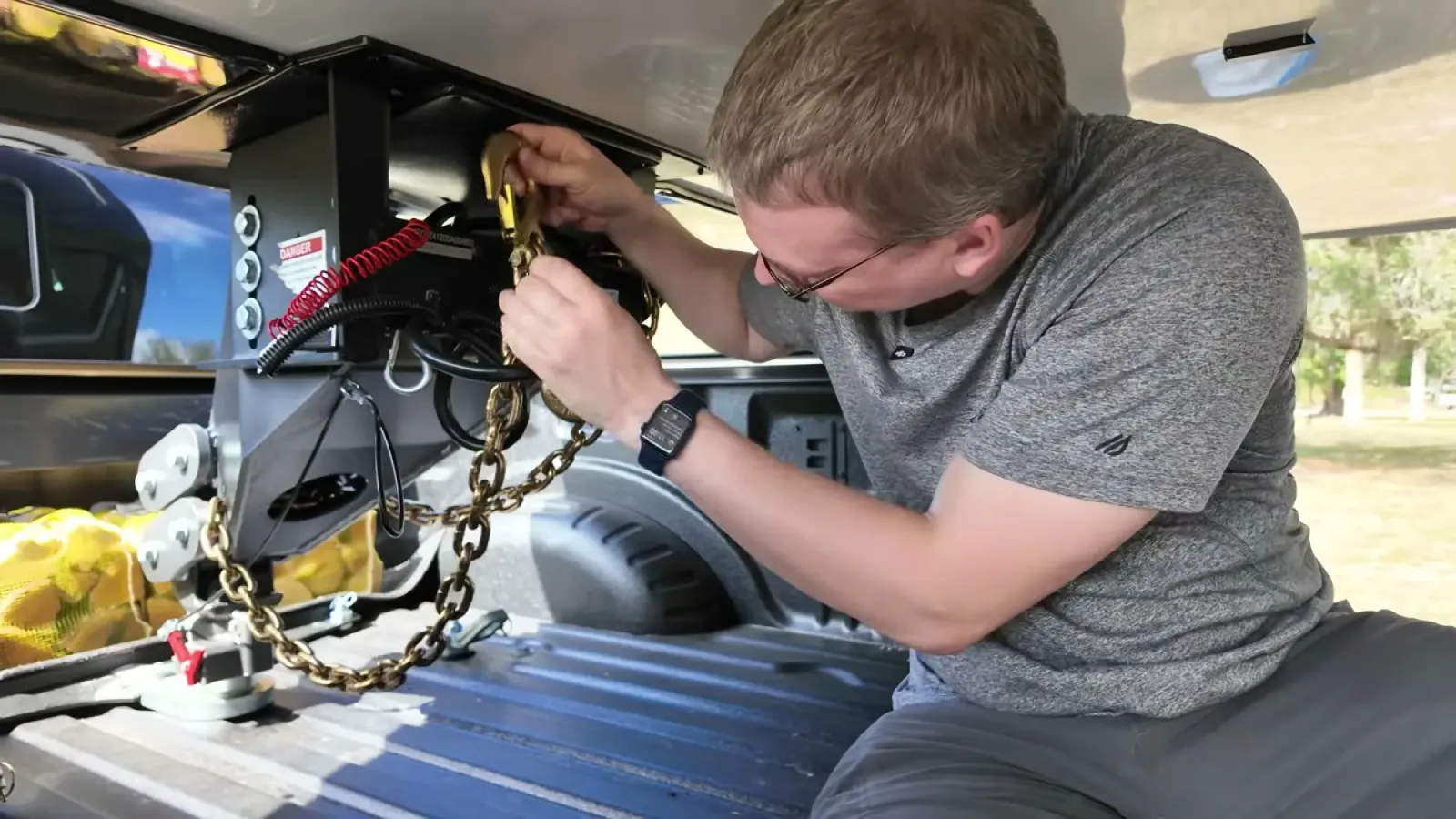
Now it's routine. Back the truck under the pin, let the SnapLatch coupler close on the ball, listen for the latch, do a tug test, hook the chains and breakaway cable. We've found the SnapLatch easy to put in and take out.
We also use a key-locking coupler lock that slides into the GEN-Y. Ours is GEN-Y's InfiniteRule SnapLatch coupler lock, $78.95 when we bought it in January 2026. It goes on a lot: when we leave the rig with the coupler sitting on the jack or tripod, so it's harder to steal; on long travel days with mountain grades, just for extra peace of mind; and when we stay hitched for days, like a recent week of boondocking and Walmart overnights without unhitching. We've never had the coupler come loose, and as far as we know it can't detach while it's locked.
The hitch also carries real weight. Our Brinkley put 3,600 pounds of pin weight on the truck when we crossed a CAT scale, against a 3,884-pound pin weight rating on our F-350. That outing is its own comedy of errors, and we broke down the actual results over dinner afterward. If you tow heavy, weigh both hitched and unhitched. The difference is your pin weight, and it's the number your hitch and your payload both care about. What our tight margin means for us is in how to tow a fifth wheel.
What to know before buying
A few honest notes. The gooseneck ball sits in the bed even when the trailer is off, and it is exactly head height when you lean over the tailgate. We keep a pool noodle over ours, for reasons Nathan's forehead can explain. Confirm your truck has the factory puck system before ordering the GoosePuck, since that's what it's built for. And hitching skill fades: after two months parked, our first hookup felt like starting over, so expect the routine to take longer after a long stay.
Maintenance is light. Nathan greases the ball and the hitch, and after each move he wipes the grease off so it doesn't end up on anything else in the bed.
One thing we'd tell anyone getting a GEN-Y through a dealer: make sure you also get the safety chains. Ours came from our RV dealer without them. Have them before you tow.
5th wheel to gooseneck adapter FAQ
What is a 5th wheel to gooseneck adapter?
It's a part that lets a fifth wheel trailer tow on a gooseneck ball instead of a fifth wheel hitch. The type we use, the GEN-Y Executive, replaces the trailer's whole pin box and ends in a gooseneck coupler. The truck then only needs a 2 5/16-inch ball in the bed.
Does a 5th wheel to gooseneck adapter replace the king pin?
On the Executive, yes. The factory pin box, kingpin included, comes off and the GEN-Y box bolts on in its place. GEN-Y's installation guide covers the swap.
How do you install a 5th wheel to gooseneck adapter?
For the Executive, GEN-Y's steps are: remove anything attached to the old pin box, support it, unbolt it and lower it, lift the new box into place at a height that tows level, add shim plates if your frame needs them, and torque at least four bolts per side to 160 ft-lb, then re-torque after 50 miles. Ours was installed by our RV dealer before we picked the trailer up, so follow the manufacturer's guide for your model, or have a shop do it.
How much does a GEN-Y 5th wheel to gooseneck adapter cost?
GEN-Y lists the gooseneck Executive at $1,799.95 to $1,999.95 depending on frame type and weight tier (checked October 2026). Ours came with our RV purchase, installed by the dealer. You also need a ball: we paid $466.59 for our GoosePuck in December 2024, and the current GEN 2 version lists at $529.95.
Do I need a gooseneck hitch in the truck to use one?
You need a 2 5/16-inch gooseneck ball in the bed, plus anchor points for the safety chains. If your truck has a factory puck system, a puck-mounted ball like the GoosePuck drops into it. Our F-350 has one, so there's no separate under-bed hitch.
Will a gooseneck adapter work with a short bed truck?
That's our setup. We went with the 5-inch offset GoosePuck because our truck is a short bed and we wanted extra clearance between the trailer and the back of the cab. Check your own turning clearance before your first tight turn.
Does the GEN-Y come with safety chains?
GEN-Y's installation guide has a safety chain section, and its listing mentions the safety chain, so chains appear to be part of the kit when you buy it new. Ours came through our RV dealer without them. Check before your first tow, and don't tow without them.
Can you lock a GEN-Y gooseneck coupler?
Yes. We use a key-locking coupler lock that slides into the GEN-Y: when the rig is parked with the coupler on the jack or tripod, on mountain travel days, and when we stay hitched for days at a time. As far as we know, the coupler can't detach while it's locked.
Where to get it
Both pieces are on Amazon: the GEN-Y GH-8045AL Executive Torsion-Flex hitch and the GEN-Y GH-21001 GoosePuck 5" offset ball. They're sold separately, and you need both.
The hitch is the anchor of our full towing, hitching and setup gear roundup. Two other travel-day staples have their own write-ups: the VIAIR 400P compressor that airs up all eight of our tires, and the RV SnapPads that live on our landing gear.
One more piece of towing gear: the AUTO-VOX CampSync four-camera system, which lets us see the traffic behind us and down both sides while we tow. AUTO-VOX sent us the kit for free and paid us to feature it in a video. Our deal: code NOMADA88 for an extra discount at Amazon checkout. AUTO-VOX sets the amount and how long it runs. Get it on Amazon.