
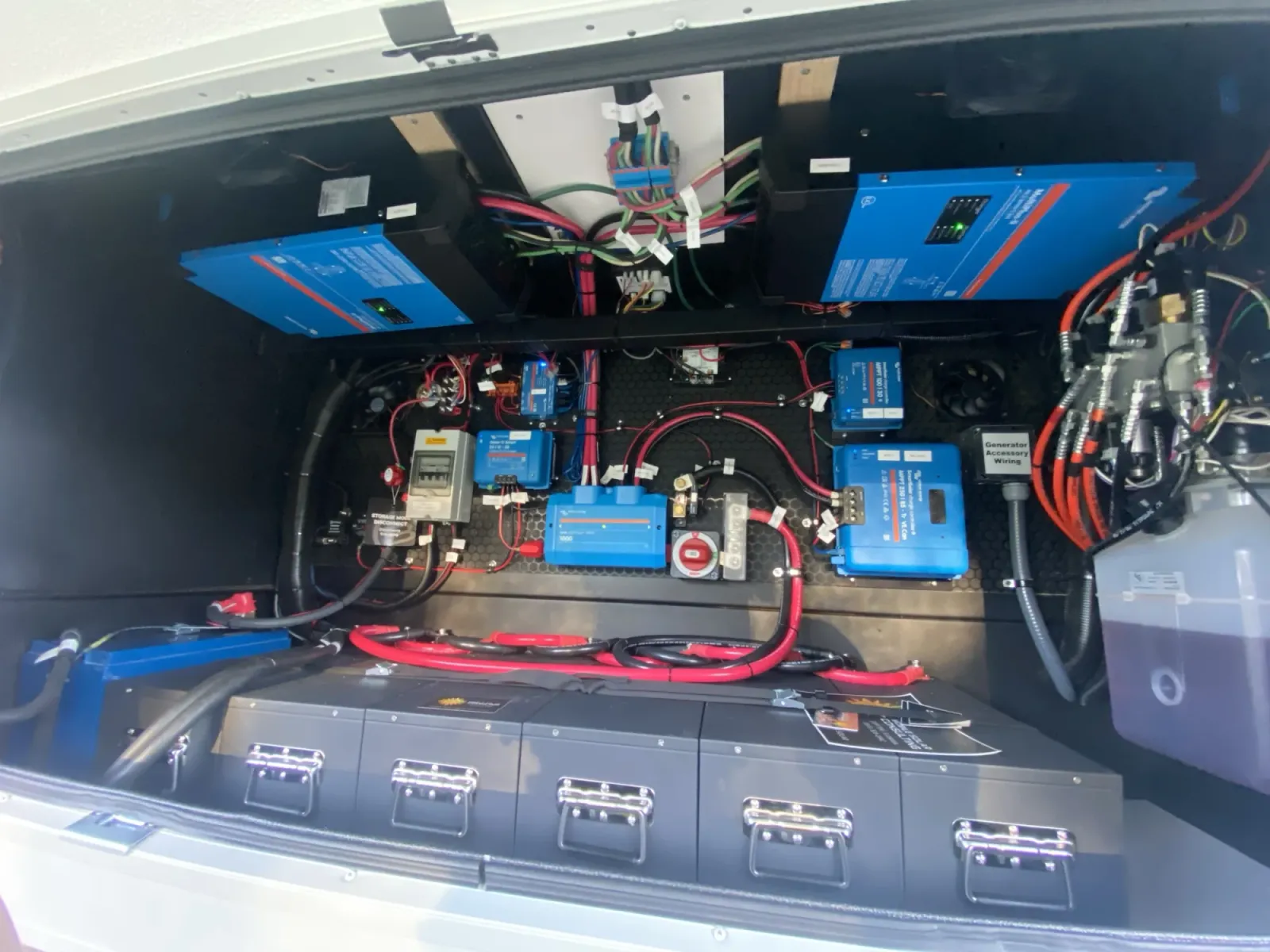
We live full-time in a Brinkley Model Z 3515 fifth wheel and we do not carry a generator. Everything runs on solar, and the part of that system doing the heaviest lifting is the battery bank: SOK lithium batteries. After months of boondocking on them, including running the air conditioner in Florida heat, our verdict is simple. They are the reason we can skip the generator entirely.
Some links on this page are affiliate links. As Amazon Associates we earn from qualifying purchases, at no extra cost to you. We only recommend gear we actually own and use.
Why we bought them
When we planned the electrical system for full-time living, we knew we wanted to boondock a lot, and we knew we did not want a generator humming next to the rig. That means the batteries have to do everything: carry the fridge through the night, absorb whatever the panels produce during the day, and hold steady when the air conditioner or air fryer kicks on.
Lead acid was never really in the running. Lithium charges faster from solar, holds its voltage under heavy loads, and can be drawn down much further without damage. Within lithium, we went with SOK on the recommendation of Mobile Solar Consulting, who designed and installed our whole system. We dropped the Brinkley off with them and picked it up with panels on the roof, a Victron inverter, and the SOK bank wired in underneath.
How we use them
Here is how much we trusted the setup: our first-ever camping trip in the Brinkley was a 15-day boondocking challenge at a primitive campground in Central Florida. We drove straight from the installer to the site, which you can read about in the day-one post. The batteries carried us through every night, and by the end of the first week they had powered two people working full time, cooking every meal, living normally, with no hookups anywhere in sight.
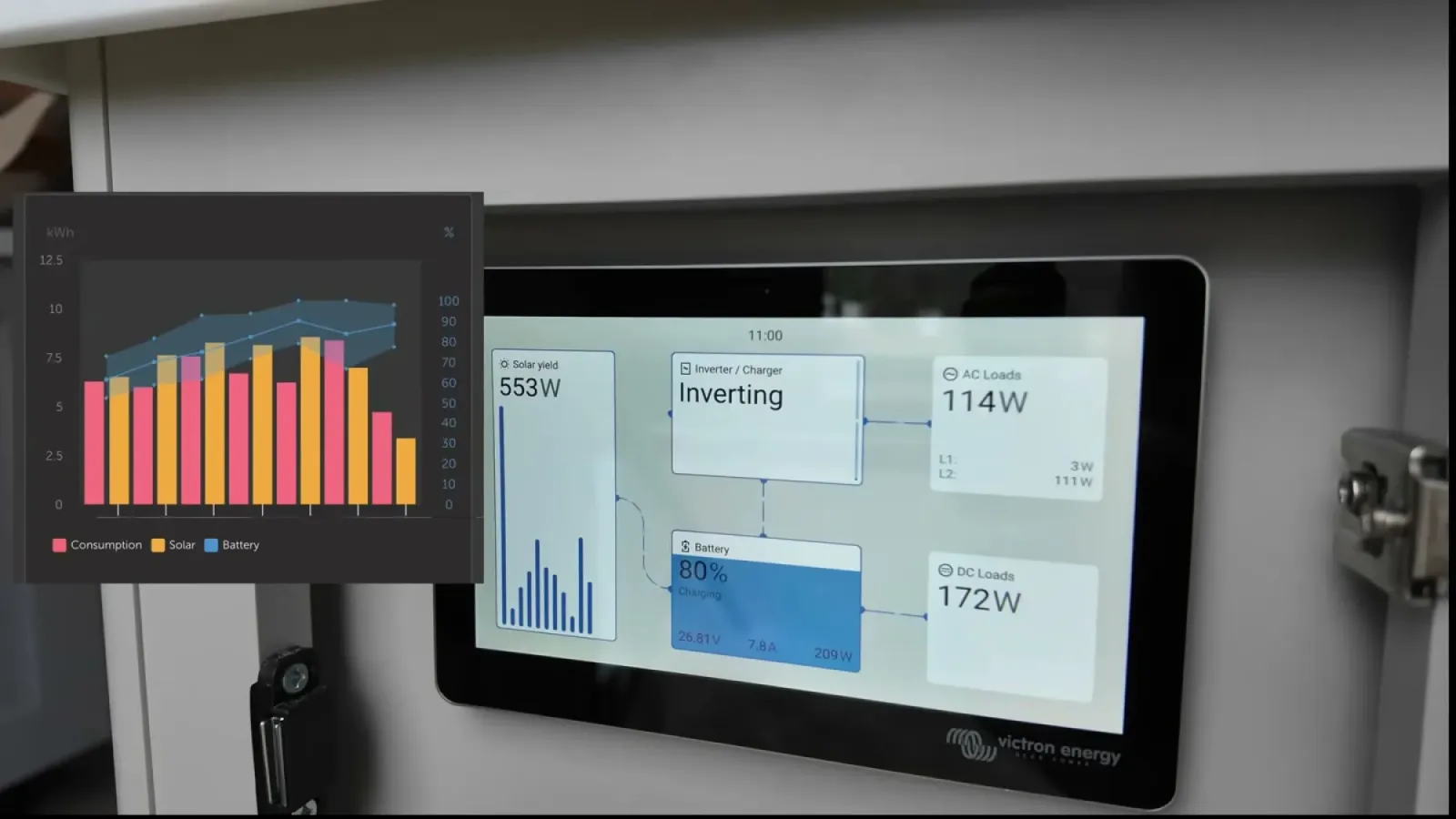
We watch them constantly through the Victron gear that manages the system. A battery shunt counts every amp in and out, so the state of charge on the touchscreen is a real number, not a voltage guess. Most of the battery check-ins in our videos are us standing in front of that screen, and we can pull the same numbers up on our phones from bed.
The one time the bank got into real trouble was our fault. Near the end of the 15-day challenge we parked in shade, the panels stopped producing, and we watched the percentage drop a little more every hour until a neighbor bailed us out with a borrowed generator. That whole scramble is here. The batteries did exactly what batteries do: they gave us everything they had, and then the math caught up with us.
Amp hours: what our battery bank actually holds
An amp hour (Ah) is a measure of stored charge: one amp flowing for one hour. In theory a 100Ah battery can deliver 1 amp for 100 hours, 10 amps for 10 hours, or 100 amps for one hour. It's the number printed on every battery, and usually the first one people compare.
On its own, though, it doesn't tell you how much a battery holds. A 100Ah battery at 24 volts stores twice the energy of a 100Ah battery at 12 volts. Multiply amp hours by volts and you get watt hours, and watt hours are what the fridge, the laptops and the air conditioner actually use up.
Here is our bank worked out that way. Six SOK 24V 100Ah batteries in a 24 volt bank come to 600 amp hours at 24 volts, which is 14,400 watt hours, or about 14.4 kWh. When Mobile Solar Consulting walked us through the system on pickup day, they called it 15 kilowatt hours. Separately there's a 12V 100Ah lithium battery, roughly another 1.2 kWh, kept as a backup. The way they explained it, that one is there so we can still pull in the jacks and slides and go find sun if we ever run the main bank flat.
What 1% of our bank looks like
One percent of 14.4 kWh is about 144 watt hours, or 6 amp hours at 24 volts. That makes the percentages on our Victron screen easy to translate. A few real ones from our first boondocking trip:
- On a cold night during our first week off-grid, we tried heating with the electric fireplace instead of propane. It drew about 1,200 watts, and over about four hours it used something like 40% of the bank. It didn't heat the whole rig either, so we switched to propane.
- Late in the 15-day challenge, parked in shade, we worked out that running the bedroom fan overnight (just the fan, not the air conditioner) was costing us about 20% of the bank. The next night we unplugged everything we could, Starlink included, and left only the fridge, our phones and a bug light. The overnight drop came down to about 5%. That's still what we do when the sun has been weak: Starlink, the air conditioners and our computers go off at night, the fridge and the rig's own systems stay on, and we use very little of the bank.
- On day one, sitting at 99% with very little running, the Victron screen estimated 3 days and 8 hours left at that rate. On day 11, at 39% with one light on, it said 3 days and 20 hours.
So what does 600Ah at 24 volts get us? Enough to run the air conditioner on a hot Florida afternoon, and to keep two full-time remote jobs and Starlink going. What it can't do is carry us through a week of shade. The bank still has to be refilled, and with about 2,770 watts of panels on the roof, that's the sun's job. The week we learned that is in our stuck-without-power post.
How many amp hours do you need?
Start with your loads, not the battery. List what you'll run and for how long, add it up in watt hours per day, then divide by your bank's voltage to get amp hours. Lithium can be drawn down much further than lead acid, which is part of why lead acid was never in the running for us, but leave room for cloudy days. Our own system came out of exactly that kind of list, which is how it ended up at 24 volts with two inverters. Why our RV runs a 24V battery bank and two inverters has the reasoning.
If you'd rather have someone experienced do the math, Mobile Solar Consulting designed and installed ours. Code NOMADSAMOR gets you half off their design consultation package, or a free AC soft starter with a qualifying installation. Their shop is here.
What to know before buying
Lithium costs more up front than lead acid, and a bank sized for full-time boondocking is a real investment. We think it pays for itself in usable capacity and generator-free quiet, but go in with open eyes.
Batteries are also only half the purchase. Without a shunt and a proper monitor you are guessing at your state of charge, and guessing is how you end up where we did that shady week. Budget for monitoring, and think about the whole system: panels, charge controller, inverter, and batteries all have to be sized for each other. If that sounds like a lot, it is, and it is exactly why we handed the design to professionals instead of doing it ourselves.
One honest limit to our experience: we are still in our first year on this bank. We can tell you they have sailed through Florida heat, Wisconsin heat advisories, and months of full-time use without a hiccup. We cannot tell you what year five looks like yet.
Where to get them
You can grab the batteries on Amazon. If you want the batteries as part of a full system, Mobile Solar Consulting designed and installed ours, and the code NOMADSAMOR gets you half off their design consultation package, or a free AC soft starter with a qualifying installation.
The batteries are one piece of a bigger picture. Our full solar and battery setup covers every component around them, Starlink is what those batteries power so we can work from nowhere, and the Blu Tech AR3 water filter handles the other half of staying off-grid: water.
Amp hours FAQ
What are amp hours?
An amp hour is one amp of current flowing for one hour. It measures how much charge a battery stores. A 100Ah battery can in theory deliver 10 amps for 10 hours. To compare batteries at different voltages, multiply amp hours by volts to get watt hours.
How do you convert amp hours to watt hours?
Multiply amp hours by the battery's voltage. A 100Ah battery at 12 volts holds 1,200 watt hours. A 100Ah battery at 24 volts holds 2,400. Our six 24V 100Ah batteries come to 14,400 watt hours, about 14.4 kWh.
How many amp hours is your RV battery bank?
600 amp hours at 24 volts: six SOK 24V 100Ah lithium batteries, about 14.4 kWh in all. There's also a separate 12V 100Ah lithium battery as a backup. Mobile Solar Consulting designed and installed the system.
Is a 24V 100Ah battery the same as a 12V 200Ah battery?
They store the same energy, 2,400 watt hours each. The difference is current: at 24 volts the same power takes half the amps, which means thinner cable and less loss. We go through that trade in why our RV runs a 24V battery bank.
How long does a 600Ah 24V battery bank last?
It depends entirely on what's running. For us, a night with the bedroom fan on used about 20% of the bank, and a night with almost everything unplugged used about 5%. Running a 1,200 watt electric fireplace for about four hours used something like 40%. With sun on the panels, the bank refills during the day.