
We tow a 40-foot fifth wheel, and when we want a free place to stay, Campendium is usually where we start. It's one part of how we find places to stay. Harvest Hosts covers one-night stops at farms and wineries, and when we want a paid spot at an RV park we just search Google. Campendium is the one for free places.
What makes it useful is that it lists a lot of free places. What makes it tricky is that the information comes from other campers, so it has issues. This guide is how we use it anyway, with a big rig, to find spots we're actually willing to pull into.
Some links on this page are referral links. If you sign up through them, we may earn a referral reward at no extra cost to you.
What Campendium is
Campendium is a campsite map with listings for free camping (dispersed public land and boondocking spots), RV parks and dump stations across North America. Campers add reviews and photos, and Campendium says it has more than 10 million reviews, photos, tips and updates. Reviews on the site carry a cell coverage rating. It runs on the website and in an app.
Campendium also sells a paid membership called RV PRO, with RV-safe navigation, a trip planner, a route tool it calls Autopilot, overnight RV parking locations and alerts when a sold-out site opens up. There's a free 7-day trial. That's all from Campendium's own site, checked October 2026. We don't pay for RV PRO. We use a free account, and the steps below use the map's filters, the listings and the reviews.
Step 1: Start with where you want to go
We pick the area we want to go to first, then open Campendium and look at what's around it.
Step 2: Filter to free, public land
Next we filter the map down to free places on public land. Campendium's map has a price filter that goes down to Free and a Public Land filter (checked October 2026).
Step 3: Turn the big rig filter off
Campendium has a Big Rig Accessible filter, and you'd think a 40-foot rig should use it. When we turn it on, a lot of spots disappear. That's not because they can't take a big rig. It's because for many listings Campendium doesn't know whether they can.
So we leave that filter off and work it out ourselves.
Step 4: Open each listing and look at the photos
We open the listings one at a time and look at the photos people have posted. What we're looking for is space. If a spot is a big open field, then in theory it might work for a big rig. We also look at the roads going in, because a spot that fits us is no use if we can't get to it.
Step 5: Read the reviews
Then we read the reviews. They tell you what problems people ran into, how their stay went, and what the signal was like.
What we look for in the reviews
When we read the reviews for a spot, these are the things we're looking for: whether people found it easy to get into, anything you have to pass through on the way in, like a fence or a gate, whether people who live nearby tend to stop by to talk, what the signal was like, and any problem that would stop us from going. If nothing in the reviews would stop us, the spot goes on our list.
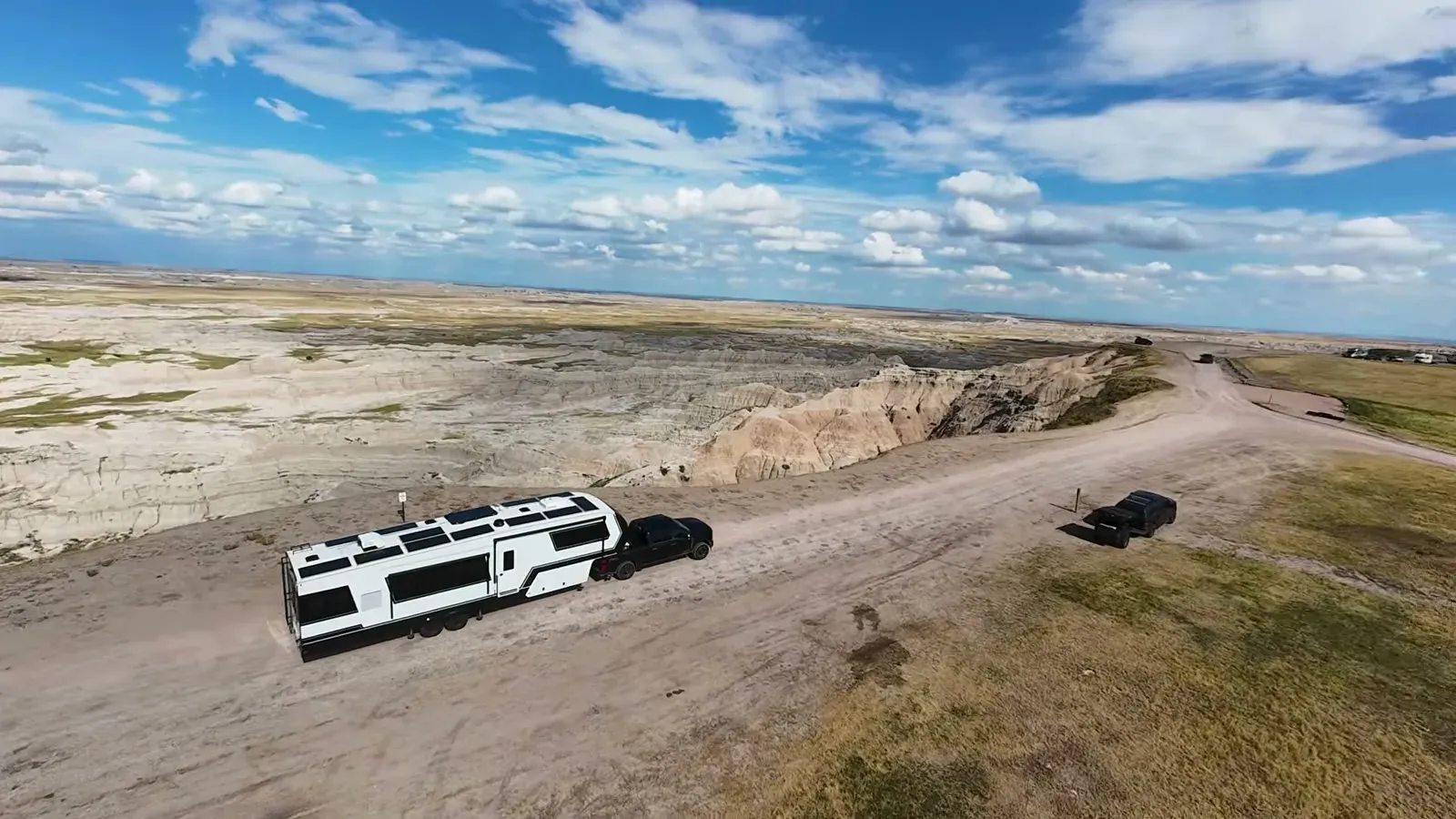
The spots we've written up, including our free stops at the Badlands and in Florida, are in Where We've Camped.
Where Campendium falls short
It isn't the be-all and end-all. Because the data is user-provided, it has issues, and the big rig filter above is one example of that. Ideally we could filter to free, public land, big rigs and no trees, and everything that fits would just show up. It's not quite there, which is why the photos and the reviews do most of the work.
How we find places to stay: Campendium vs Harvest Hosts vs Google
Campendium is one of three ways we find a place for the night. Each one is for a different kind of stay.
| What we use it for | What it costs | |
|---|---|---|
| Campendium | Free places, mostly on public land. We filter, then read the photos and reviews. | We use a free account with the map, filters and reviews. Campendium also sells a paid RV PRO membership. |
| Harvest Hosts | One-night stays at wineries, farms, breweries and golf courses. We're on All Access, which also includes Boondockers Welcome locations. | A yearly membership. Regular prices were $99 to $179 a year when we checked in October 2026. |
| Paid RV parks, when we want a paid spot. | Whatever the park charges. |
Harvest Hosts has its own write-up in our Harvest Hosts review. Our deal: Our referral link gets you a discount on the membership. Join Harvest Hosts.
For a quick free overnight on a travel day, there's also the parking lot route, which is in overnighting at Walmart in an RV. And once you've found a spot, our boondocking setup covers how we handle water, power and waste with no hookups.
This guide describes how we find places to stay with our own rig. We are not RV technicians, and this post may contain mistakes or steps that don't apply to your setup. Proceed at your own risk, check access and local rules before you go, and double-check anything safety-critical.
Campendium FAQ
What is Campendium?
A campsite map with listings for free camping, RV parks and dump stations, built on reviews and photos from campers. We use it to find free places to stay on public land.
Is Campendium free?
Campendium sells a paid membership called RV PRO, with RV-safe navigation, trip planning and overnight parking locations, and offers a free 7-day trial (checked October 2026). We don't pay for it. We use a free Campendium account and the map, its filters, the listings and the reviews to find free spots.
Does Campendium work for big rigs?
It has a Big Rig Accessible filter, but when we turn it on a lot of spots disappear, because Campendium often doesn't know whether a site fits a big rig. We tow a 40-foot fifth wheel, so we leave the filter off, then look at the photos for open space and read the reviews about the road in.
Is Campendium data reliable?
It's user-provided, so it has issues. We treat it as a starting point. The photos and the reviews tell us the most: problems people had, how their stay went, and what the signal was like.
Campendium or Harvest Hosts?
We use both, for different things. Campendium is where we look for free spots on public land. Harvest Hosts is a paid yearly membership for one-night stays at farms, wineries and other businesses. When we want a paid RV park, we search Google.