
If you have a fifth wheel and no sewer hookup, a macerator pump is what makes the whole waste situation workable. It grinds and pumps through a small hose instead of relying on gravity through a big one, which matters when your waste outlet sits high off the ground and the dump station is somewhere else entirely.
Ours quit mid-dump while we were parked at Nathan's parents' place with no hookup. We were minutes from ordering a replacement we did not need. Here is what a macerator actually does, and the troubleshooting order that saved us the money.
Some links on this page are affiliate links, including Amazon links. As Amazon Associates we earn from qualifying purchases, at no extra cost to you. We only list gear we actually own and use.
What an RV macerator pump is, and how it works
A standard sewer hose is three inches across and works on gravity. That is fine at a full hookup site where the ground slopes your way. It is much less fine when you are moving waste into a portable tote tank sitting in a truck bed, which is above the outlet rather than below it.
A macerator solves that. It grinds solids and pumps the result through a garden-hose-sized line, uphill if it has to. That is what makes the tote-and-truck routine practical with a fifth wheel, and the full procedure is in how to dump RV tanks with a portable tote tank.
The trade is that you have added a motor with an impeller to the dirtiest system on the rig. Motors seize. That is the failure you should expect, and it is the one almost nobody warns you about.
Do you actually need one?
If you always stay at full hookup sites and your rig sits level with the sewer connection below your outlet, no. Gravity and a normal hose will do the job and you have one less thing to break.
You want one if any of these describe you: you boondock or moochdock and have to haul waste to a dump station, your fifth wheel's outlet sits high relative to where the tote goes, you dump into a portable tank in a truck bed, or you are ever connecting to a cleanout that is uphill from the rig.
For us it is not optional. A fifth wheel's outlet is well off the ground, the tote rides in the truck bed above it, and gravity flatly refuses to help with that arrangement.
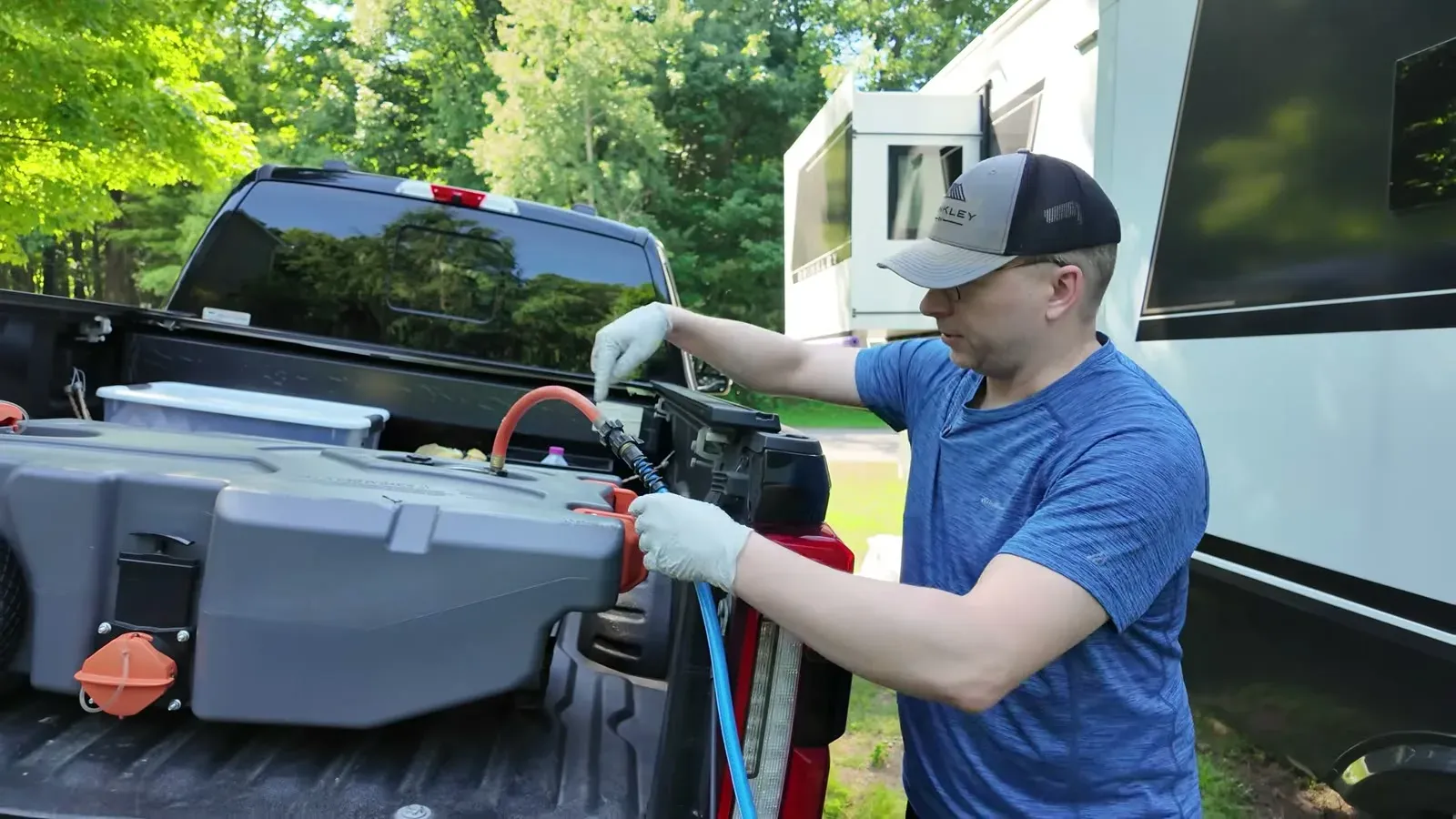
The pump had power and would not run
Our sequence, which is worth copying because it rules things out in the right order:
Everything was connected, valves were open, no leaks anywhere. We hit the switch and got nothing.
Power is the obvious suspect, so we worked it first. The pump was plugged in. The green light on the inside panel was lit. We reseated the connection at both ends. We even moved the plug over to the truck and started the engine to take the RV's outlet out of the equation entirely.
Green light. Still nothing.
That is a frustrating place to land, because ruling something out does not fix anything. It does tell you where to stop looking, though, and it pointed straight at the pump itself.
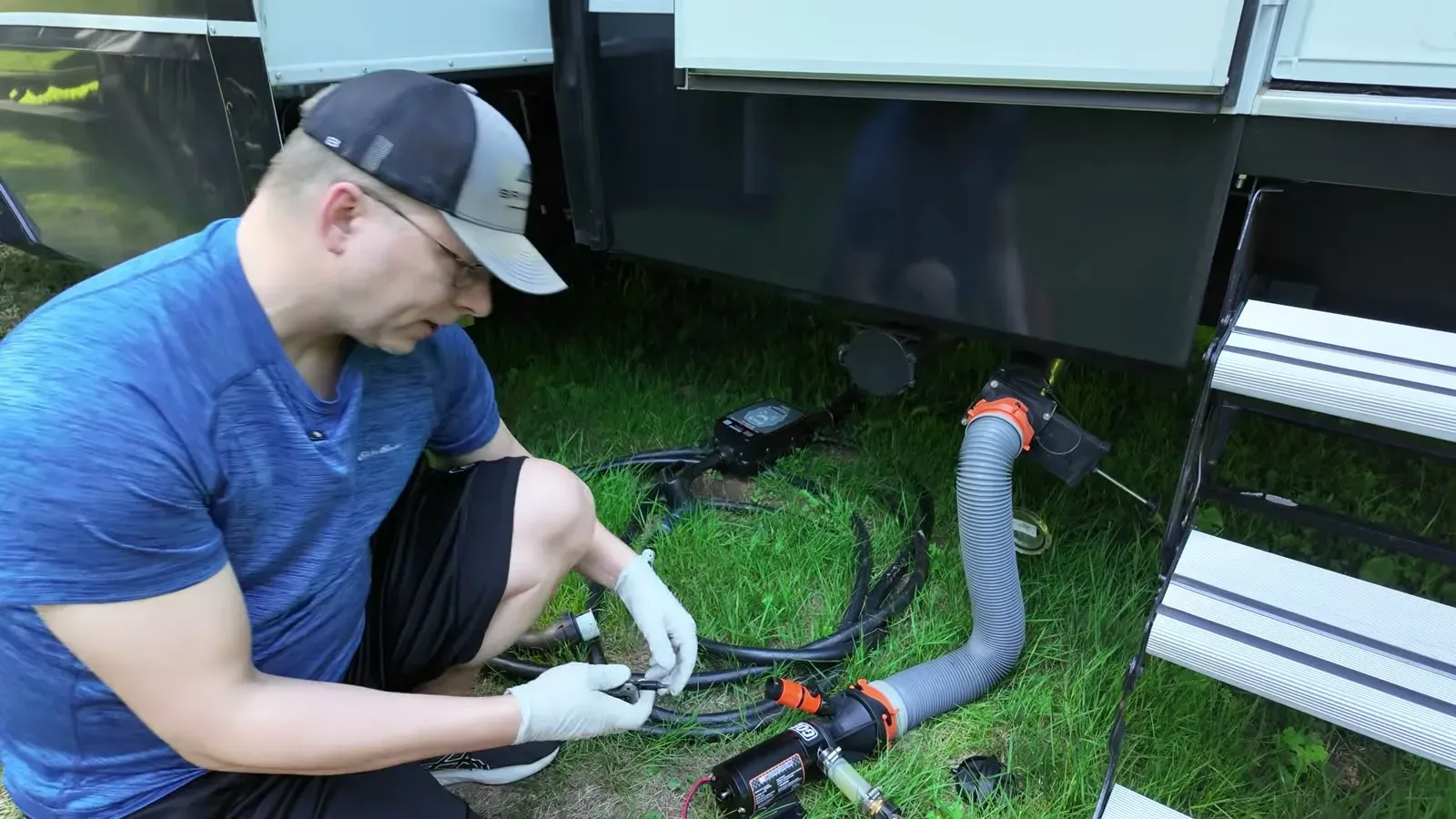
The fix: turn the impeller by hand
There is a cap on the back of most macerators. Behind it is the end of the shaft that drives the blade inside, and it is there specifically so you can turn the impeller manually.
Unscrew the cap, get a screwdriver onto the shaft, and rotate it.
Here is the part that cost us an hour. Nathan tried it, felt it move slightly, and concluded it had not helped. That was the mistake. You have to keep going and turn it all the way around, not just nudge it. With a longer screwdriver that could actually get purchase, he turned it much further, the motor caught, and the pump ran.
So it was seized, not dead. Something inside had stiffened enough that the motor could not break it loose on its own, but once the shaft moved by hand the pump was completely fine.
If your macerator hums at you, or does nothing at all, and you have already confirmed it is getting power, do this before you buy anything.
When it keeps seizing
Ours did not stay fixed. It would run for a while, stop, and need the screwdriver again. We got the kitchen tank done, then the black tank, that way.
If you are in that loop, the trick we landed on is putting a drill on the shaft instead of turning it by hand. Which works, assuming you own drill bits, which we did not, which is how a hardware store run became part of a dump day.
Repeated seizing means the pump is telling you something. Usually it has sat too long between uses, or it was not flushed properly after the last one. Ours had not been run in about a year. Run it more often than that, and give it clean water through the hose at the end of every dump.
The other failure mode: the power side
Later the same day the converter stopped showing a light at all, and the pump would not run even with the manual trick. We think we blew a fuse.
Worth knowing before you go shopping: nobody at a general hardware store stocks RV parts, and nobody on the floor had heard the word macerator. Fair enough, honestly. We ended up ordering a replacement cable from Amazon rather than a whole new pump, because everything pointed at the power side and not the motor.
That is the real lesson. A macerator has two things that fail, the motor seizing and the power path, and they present almost identically as "I hit the switch and nothing happened." Work out which one you have before you spend two hundred dollars on the wrong answer.
The short troubleshooting order
- Confirm the valves are actually open and the hoses are connected the way you think. Do this first, every time, because it is free.
- Confirm power at the pump. Reseat both ends. Try a different outlet, including the truck, to take the rig's wiring out of it.
- If it has power and will not spin: pull the cap on the back and turn the shaft with a screwdriver, all the way around, further than feels reasonable.
- If it spins freely by hand and still will not run under power, suspect the cable, the fuse or the converter rather than the motor.
- Flush the pump with clean water at the end of every dump, and run it more often than once a year.
What else we would tell you
The kitchen tank came out much cleaner than the previous time, which we put down to not waiting fourteen days to deal with it. Tanks are easier when you do them sooner, which is the least surprising and most ignored advice in RV life.
Our full waste kit, including the pump, the hoses and the valves, is in our RV sewer and tank gear post, and how it fits together with water and power off-grid is in our boondocking setup.
And the thing Fabiola said while we stood there watching a pump not work, which is the actual point: when a project starts going sideways it is easy to spiral about what it will cost and what you do now. Do the research, stay calm, and you usually figure it out. We have had enough of these days now to believe it.
This describes our own pump and our own troubleshooting. We are not RV technicians. Waste systems are a place for gloves, and anything involving 12V wiring or fuses is worth handing to someone qualified if you are not sure.