
We did not design our electrical system. Mobile Solar Consulting did, and when we picked the Brinkley up from them we understood roughly none of it. Two years later we get asked about the same three things every time it comes up, usually by someone about to spend money on their own build.
Why 24 volt batteries when the rig runs on 12. Why two inverters instead of one bigger one. Why two charge controllers.
Here is what we have learned about the reasoning, from living with it rather than from designing it.
Some links on this page are affiliate links, including Amazon links. As Amazon Associates we earn from qualifying purchases, at no extra cost to you. We only list gear we actually own and use.
The setup, briefly
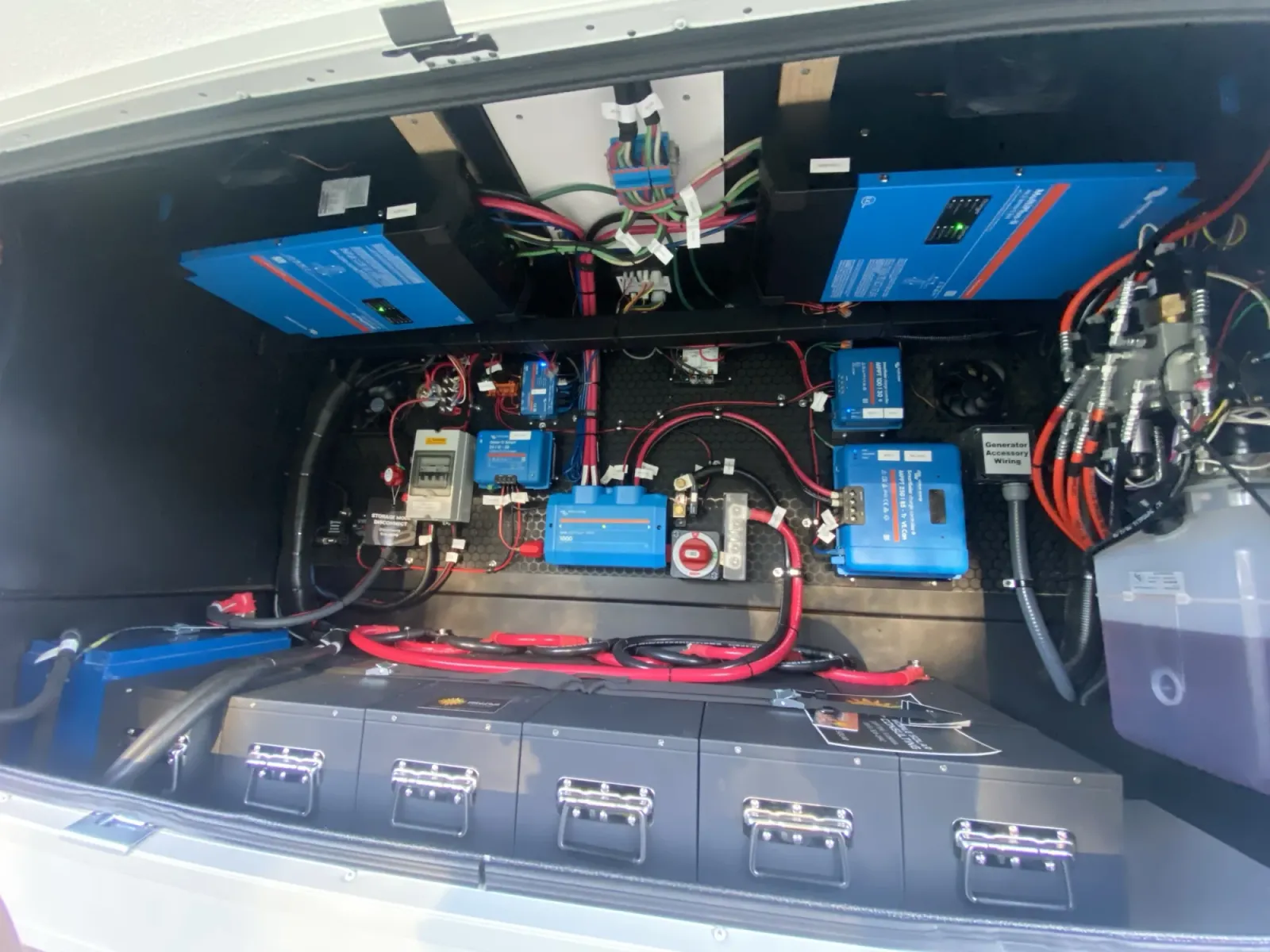
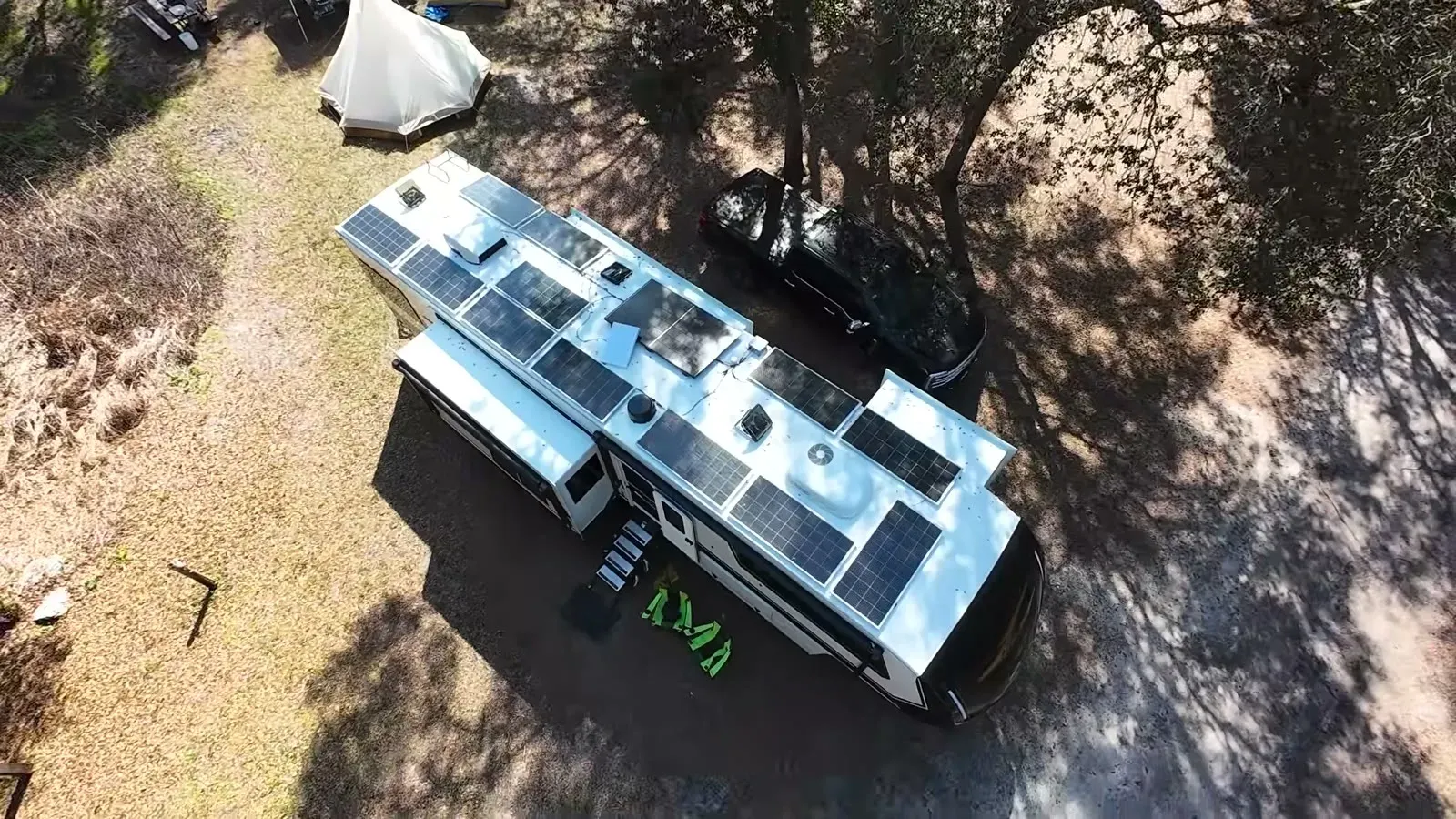
Six SOK 24V 100Ah lithium batteries make up the bank. Twelve RICH SOLAR 200 watt panels plus the 370 watt panel the Brinkley came with put about 2,770 watts on the roof. Between them sit two Victron MultiPlus 3000VA inverter/chargers, two SmartSolar MPPT charge controllers, a Cerbo GX with a GX Touch 70 screen, a Lynx power distributor and a pair of Orion-Tr DC-DC chargers.
The component-by-component version is in our off-grid solar setup post. This one is about why the pieces are arranged the way they are.
12V vs 24V: why our batteries are 24 volt when the rig is 12
This is the choice that confuses people most, and the physics behind it is simple enough.
Power is volts times amps. If you want 3,000 watts out of a 12 volt bank, you are pushing around 250 amps. Get the same 3,000 watts from a 24 volt bank and you are pushing around 125. Half the current for the same work.
Current is what forces you into expensive cable. Thick copper, big lugs, heavy fuses and busbars, all sized for amperage rather than wattage. Current is also what turns into heat in a wire and gets lost on the way. Doubling the voltage halves the current, which cuts the cable size you need and the losses you eat, and on a system this size that is real money and real efficiency rather than a rounding error.
The catch is that an RV is not a 24 volt appliance. The lights, the water pump, the fans, the slides and the leveling system all expect 12 volts, because that is what the factory built. So a 24 volt bank cannot just feed the rig directly.
That is what the two Orion-Tr DC-DC chargers do. They sit between the 24 volt bank and the rig's 12 volt side and step the voltage down, so the house systems get the 12 volts they were designed for while the heavy lifting happens at 24. It is a translation layer, and it is the price of admission for going 24 volt in a vehicle built around 12.
Worth being honest about the trade: this adds parts, adds cost, and adds one more thing that can fail. If you are building something small, 12 volt end to end is simpler and there is nothing wrong with it. The higher voltage starts paying off when the loads get big, and ours got big the moment air conditioning was on the list.
Why two inverters
The short answer is that one 3,000VA inverter would not cover what we actually do.
An inverter has a continuous rating and a surge rating, and both matter. Running the air conditioner is a serious continuous load on its own. Then someone starts the air fryer, or the induction burner, or the microwave, and a single inverter is suddenly the thing deciding what you are allowed to use.
Two MultiPlus units let us pull those at the same time instead of choosing. The first meal we cooked on the Blackstone came with fries from the air fryer, off-grid, in the middle of nowhere, and nobody had to go turn the AC off first. That sounds like a small thing. Living in it, it is the difference between an off-grid system and an off-grid system you have to think about all day.
There is a second benefit that is easy to miss: a MultiPlus is an inverter and a charger in the same box. When we do plug into shore power, they reverse and become the battery charger, and having two of them means the bank refills faster after a stretch of bad weather.
We are not going to pretend we chose this configuration ourselves. It was spec'd for the loads we said we wanted, which is the actual lesson. Tell a designer how you plan to live, not which parts you want, and let the load list pick the hardware.
Why two charge controllers
The roof has two separate arrays on it. The twelve RICH SOLAR panels we added are one, and the 370 watt panel the Brinkley came with from the factory is another, with different characteristics.
Feeding both into one controller means the whole array behaves like its weakest section. Splitting them means the big SmartSolar MPPT 250V/85A optimizes the main array while the smaller 100V/20A handles the factory panel, and neither one drags the other down.
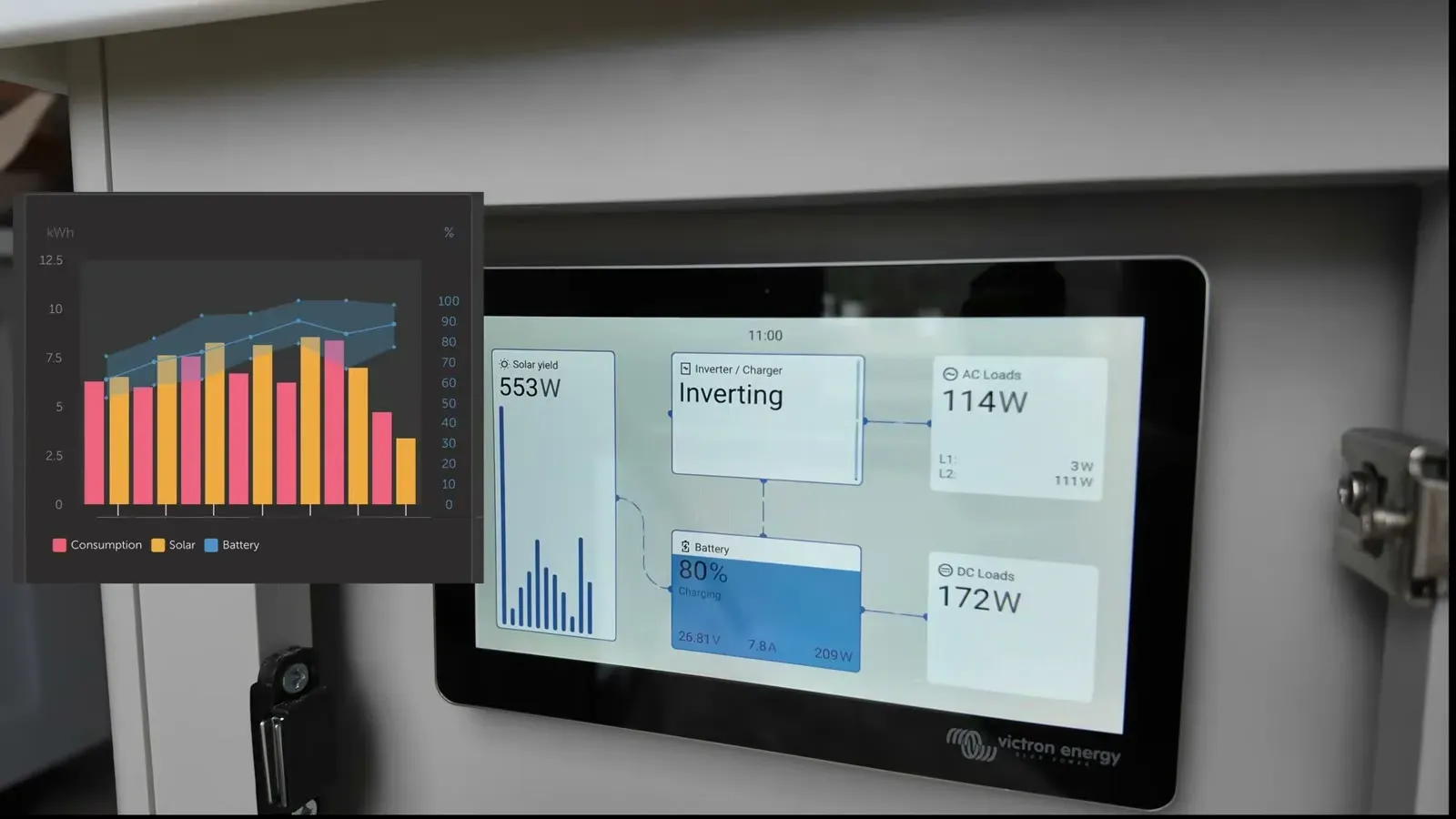
Both have Bluetooth, so we can check what each is producing from inside the rig. On a bright morning that is a satisfying number. On a shady afternoon it is an early warning, and we have learned to treat it as one.
The parts nobody photographs
Two components do quiet work that the system would be much worse without.
The Lynx distributor is a busbar that ties the bank together in one place, with fusing built in. Without something like it you get a nest of cables and homemade connections at the highest-current point in the whole system, which is exactly where you do not want improvisation.
The Smart Battery Shunt sits on the negative side and counts every amp in and out. That is how the system knows the real state of charge instead of guessing from voltage, which lithium makes nearly impossible because the voltage stays flat across most of the usable range. Every battery percentage we read on camera comes from the shunt. Without it those numbers would be decoration.
What we would tell someone starting out
Work out the loads first. Everything above follows from a list of what we wanted to run at the same time, and the list is what drove the voltage, the inverter count and the cable sizing. Picking components first and hoping they add up is how people end up with a big battery bank that still cannot start an air conditioner, which is a problem we cover in our post on the soft start.
Pay for the design even if you do the install. Mobile Solar Consulting designed and installed ours, their shop is here, and the code NOMADSAMOR gets you half off their design consultation package. Having someone experienced sanity-check a plan is the cheapest part of a build this size.
And accept that the best system in the world does not make power out of nothing. We spent the back half of a 15-day boondocking challenge parked in shade, watching the bank drop every morning, until we borrowed a generator to get out of it. The full story is in our stuck-without-power post. Nothing in this article would have saved us. Parking where the sun is would have.
This describes our own system, designed and installed by professionals for our rig and our loads. We are not electricians. High-current DC is genuinely dangerous, and system design is not a place to copy someone else's homework.