
The night the solar install was finished, Fabiola cooked. Not because dinner was urgent, but because a kitchen that runs on sunlight is not really yours until you have used it for something that takes a while.
This is that stew. It is the from-scratch version, where the seasoning comes out of your own cupboard instead of a packet, and it is the one worth learning if you are going to make it more than once. If you have just pulled into a site exhausted and want food in twenty minutes, make the travel day version instead. Same dish, far less standing over it.
Why this one works off-grid
We do not carry a generator, so everything the Instant Pot uses comes out of the battery bank. What makes pressure cooking work off-grid is that the heavy draw is short. It pulls hard to come up to pressure, then settles into holding it.
The surprise on camera was that the sauté stage is the expensive part, not the pressure stage. While the onions were going, the system was pulling in around 1,700 watts of solar against roughly 200 watts of use, and the batteries kept climbing through the whole cook. By the time it went under pressure the bank was at 81 percent and still rising. A stew that simmers for two hours on a propane burner heats the whole rig; this one heats a pot.
The full electrical picture is in our solar and battery setup, and the pot itself is the Instant Pot we cook with off-grid.
About the seasoning
Fabiola does not measure. Her words on camera: "my seasoning, there's no measurements, I do as I feel in the day, so the meat will be unique. Sometimes it's going to have a unique flavor, but with the same base."
So the base is fixed and the amounts are yours. The base is garlic, black pepper, onion powder, paprika and salt, and the technique that matters more than any quantity is that it goes on in two passes: season, stir, season again, so the meat in the middle of the pot gets as much as the meat on top.
If you would rather not build it yourself, she says so directly: buy the pre-packaged stew seasoning and use unsalted broth. That is exactly what the travel day version does.
The one non-negotiable
Bay leaf, and fresh if you can get it. She calls it her mother's secret and does not hedge about it: meat cooked without bay leaf is a different and lesser thing. She put in four, having started at three and changed her mind because there was a lot of meat. She uses them for beans too.
Instant Pot beef stew recipe
Serves: 8 to 10. This is a big pot, and deliberately so
Pressure time: 20 minutes, then 5 more with the potatoes
Ingredients
- About 4 lb stew meat, bought already chopped
- 1 tbsp olive oil. "Just a little bit, because it's expensive"
- 2 medium onions, chopped
- 1 to 2 tbsp garlic, and more again with the seasoning. She prefers fresh and used jarred on the night
- 1 to 2 tsp each black pepper, onion powder and paprika, plus salt, split across two passes
- 3 to 4 cups unsalted beef broth, enough to cover the meat with room for potatoes later
- 4 fresh bay leaves
- 1½ to 2 lb russet potatoes, chopped, added at the end
Serve with white rice.
Steps
- Set the Instant Pot to Sauté on low for 6 minutes and add the olive oil.
- Add the chopped onions and let them brown and start to caramelize.
- Add the garlic, then the stew meat. Let the meat take on color before any liquid goes in.
- Season in two passes with garlic, black pepper, onion powder, paprika and salt, stirring in between.
- Add unsalted beef broth to cover the meat, plus a little extra for the potatoes, then the four bay leaves.
- Press Cancel, lock the lid with the valve closed, and pressure cook for 20 minutes.
- Release the pressure with a kitchen towel laid over the vent.
- Settle the chopped potatoes down between the pieces of meat, taste and adjust the salt, then pressure cook for 5 more minutes.
- Release the pressure and serve over white rice.
The longer version of each step is below.
Where these numbers come from
The seasonings are the honest problem here. Fabiola names all five and measures none of them, and says why: "there's no measurements, I do as I feel in the day." The amounts above are a starting point scaled to the meat, not something she said. Season, taste at the potato stage, and adjust. That is the actual method.
What is solid:
- Four bay leaves is exact. She counts them out, starts at three and changes her mind.
- Sauté low for 6 minutes, 20 minutes pressure, then 5 more with the potatoes are all stated.
- The meat weight is the biggest estimate. She never weighs it, but the bag she tips in is large, visibly a bulk pack rather than the family tray from the travel day version, and she picks 20 minutes specifically "because we have a lot of meat." Four pounds is the honest read of what is on screen.
- The potatoes are the basket of russets sitting on the counter behind her, six to eight of them. Unlike the travel day stew, these get chopped.
- The broth and onions are scaled from the meat, not observed. Cover the meat and leave room; that instruction is hers and it matters more than the cup count.
Method
Sauté on low, six minutes. Set the Instant Pot to Sauté, and turn it down to low. On high it is, in her words, really strong. Six minutes is enough. It starts warming before it says it is ready, so get the oil in early.
Onions first, and let them go. Olive oil, then the chopped onions. Let them brown and start to caramelize properly. This is the step people skip and it is the one that decides whether the finished stew tastes like anything.
Then the garlic. Once the onions are on their way, in goes the garlic. "This will make the whole difference, and the smell, it's amazing." Turn the vent on now, because the next stage smokes.
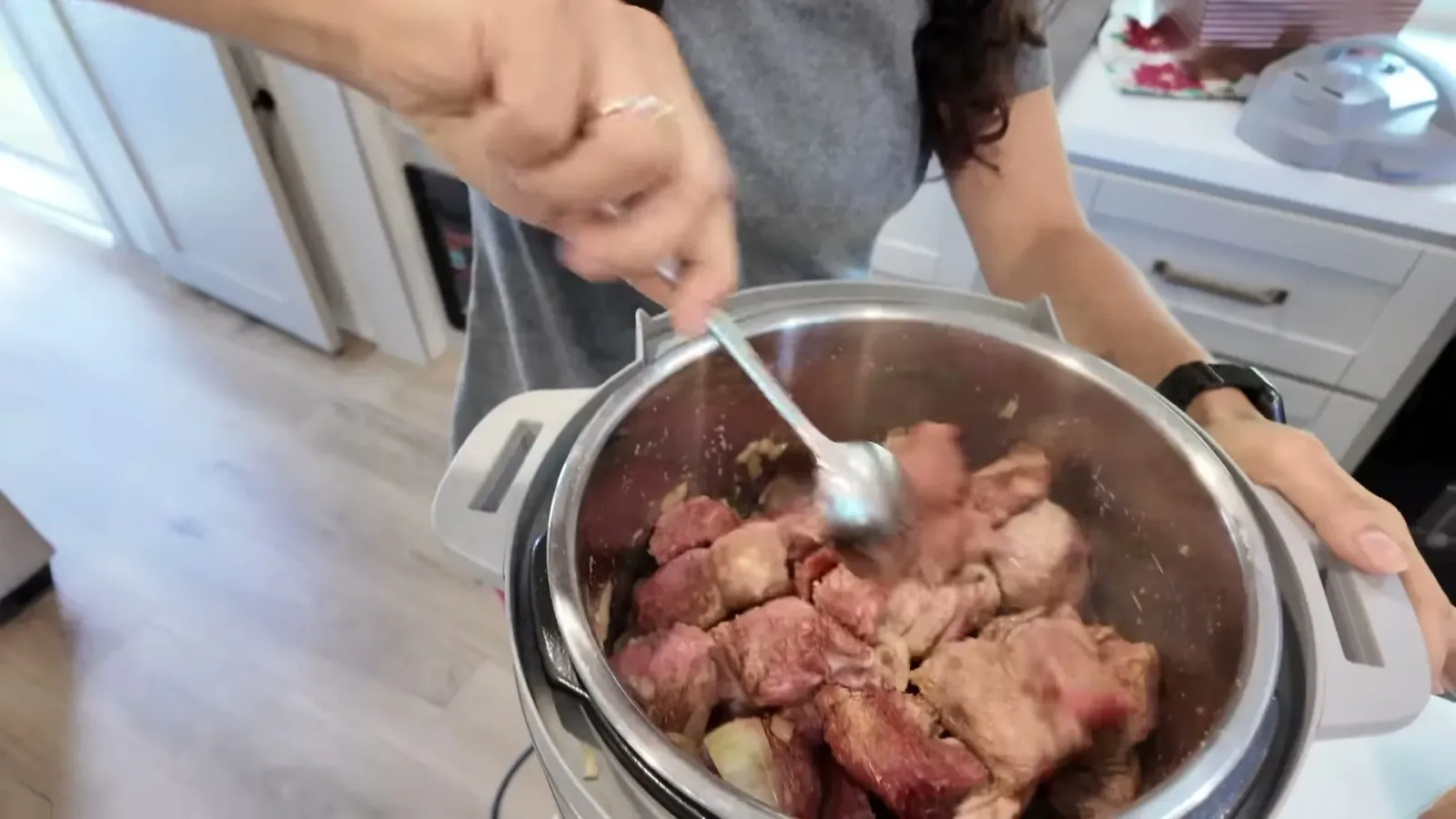
Brown the meat, and do not add liquid yet. Meat in with the onions and garlic. Let it take on color. She is explicit about why she is holding the broth back: she wants the brown on the meat before anything wet goes near it. As it cooks it releases its own water, which is also why the stew does not need much broth later.
A small warning from the night: check the package before you tip it. Hers had liquid pooled in the plastic and she ended up cooking one-handed with the other hand covered. "Do not trust the package."
Season in two passes. Garlic, black pepper, onion powder, paprika, salt. Stir. Then more of the same. The point is coverage, not quantity.
Broth and bay leaves. Add unsalted beef broth, enough to cover the meat, plus a little extra because potatoes are going in later and will want liquid. Then the four bay leaves.
Cancel sauté, seal, twenty minutes. Press Cancel. Lid on, check the release valve is closed, lock it, then check it again. Set Pressure Cook manually rather than using a preset, and give it 20 minutes. She went with 20 specifically because there was a lot of meat in the pot.
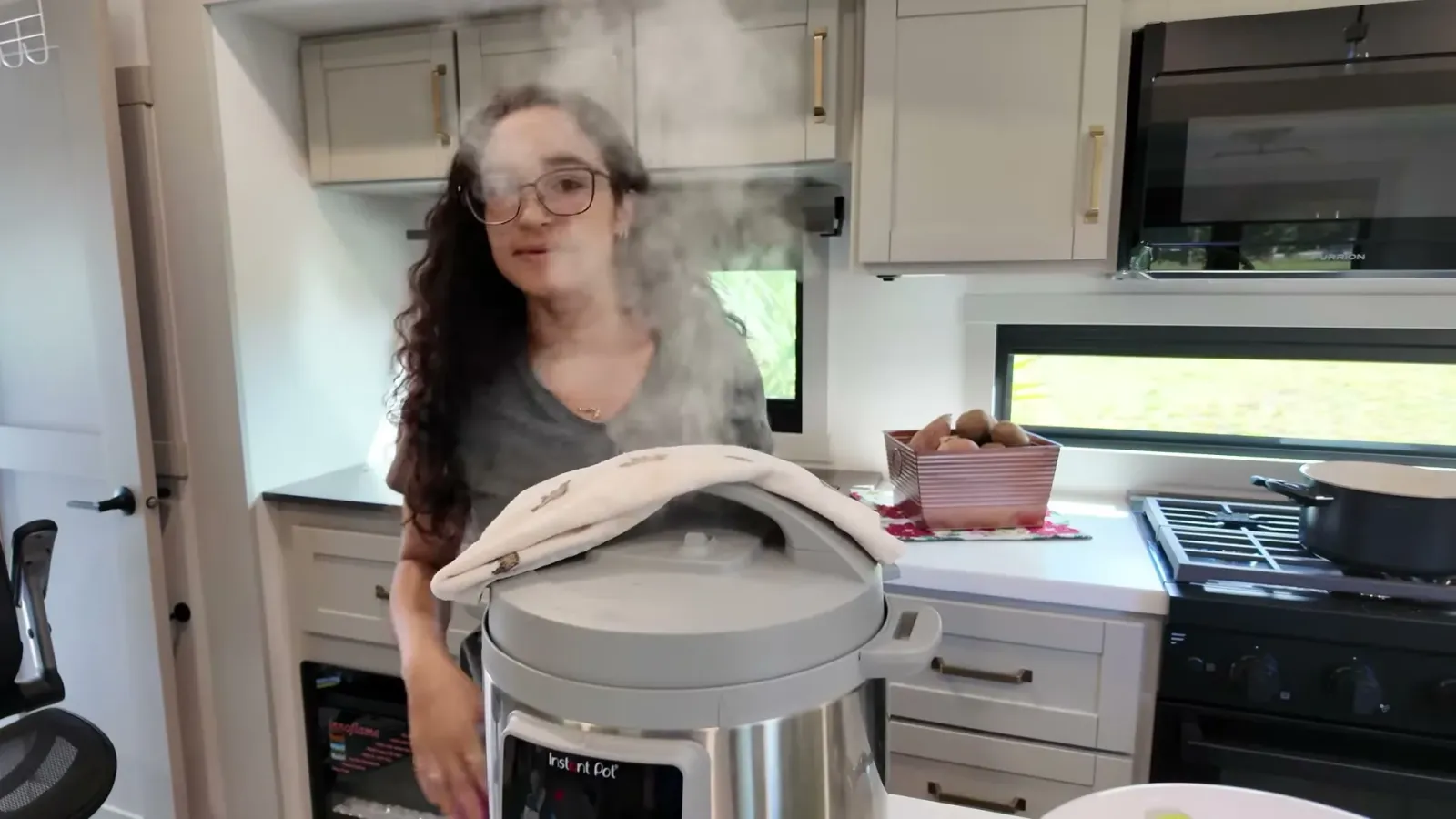
Release with a towel, and think about doing it outside. Lay a kitchen towel over the steam vent before you release, or you will be cleaning the ceiling. She got a faceful on camera and said she would run the pressure release outside next time. In a small rig this is genuinely good advice.
Potatoes, then five more minutes. Open it up. The meat should be falling apart when you push a spoon into it. Add the chopped potatoes, settling them down between the pieces of meat rather than piling them on top.
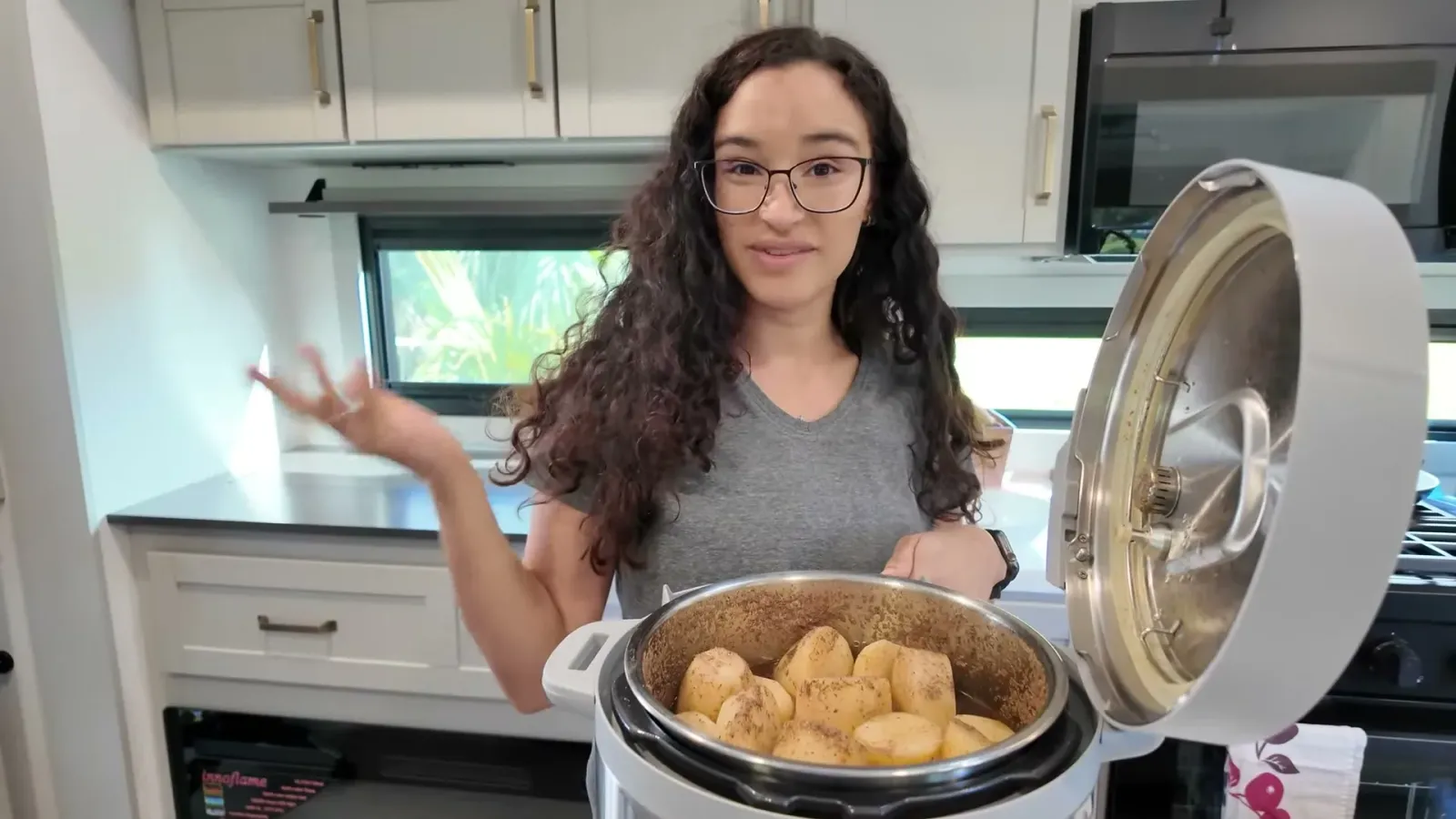
Taste it now, not at the end. This is where you fix it. Hers needed more salt, so in went salt and a little pepper, aimed at the potatoes so they would pick up flavor rather than sitting bland in a seasoned stew. Then lid back on, sealed, and 5 minutes on pressure.
Release, and serve it over white rice.
What it is like
The meat falls apart when you cut it. The potatoes go in late enough that they hold together instead of dissolving into the broth, and the broth itself stays thick rather than turning into soup, because most of the liquid came out of the meat rather than a carton.
It makes a lot. That is not an accident and Fabiola will tell you so herself: "I love to cook, but I always cook with emotion, so you know what that means."